--%>

Explain Counters

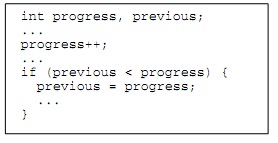
Counter variables are commonly used in many computer applications for different purposes. Here is a typical example where a variable is used to measures the progress of some activity of interest:
1146_counter1.jpg

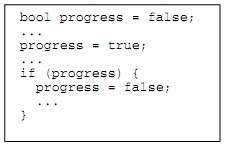
If the exact value of the progress variable or the entire range of its values is not really required for checking the property of interest, then the use of this variable can cause unnecessary (potentially infinite) state space expansion. In this case, the progress variable can be reduced to a Boolean variable:
80_counter2.jpg

This modification immediately cuts down the number of states that need to be explored for this piece of code from ((2*MAXINT)+1)2 to only two possibilities: the progress variable taking only the value of true or false. Such small modifications can lead to exponential improvements in memory and time for a model checker.

   Related Questions in Programming Languages

  • Q : Define Deadlock Deadlock : A situation

    Deadlock: A situation which occurs whenever two threads each acquires the lock to one of a set of resources which they both require.

  • Q : Define Application Application : It is

    Application: It is frequently used, simply as a synonym for the program. Though, in Java, the word is particularly employed of programs with a Graphical User Interface (GUI) which are not applets.

  • Q : Explain why java is so important for

    The internet aided java to the forefront of programming. And java consequently has had a deep effect on the internet. The reason for this is highly simple: java uses the universe of objects that can travel freely in cyber space. In a network, two broad categories of

  • Q : Explain win 3.1 supports which form of

    Explain win 3.1 supports which form of multi tasking?

  • Q : Questions on java class Array 1.

    1. Suppose we have a class A which has a constructor that takes a single integer. (a) After the following statements have been executed, how many A objects will exist

  • Q : Procedural and object-oriented programs

    Illustrate the difference between the procedural and object-oriented programs in brief.

  • Q : Explain Inheritance hierarchy

    Inheritance hierarchy: The relationship among super-classes and sub-classes is termed as an inheritance hierarchy. The single inheritance of classes means that each and every class has simply a single `parent' class and that Object class is the eventu

  • Q : What is message queue Describe the

    Describe the message queue?

  • Q : What is Class header Class header : It

    Class header: It is a header of class definition. The header provides a name to the class and states its access. It too explains whether the class expands a super class or implements any interfaces.

  • Q : Explain Static variable Static variable

    Static variable: It is a static variable defined within a class body. Such a variable fits in to the class as a whole, and is, thus, shared by all objects of the class. The class variable may be employed to define the default value of an instance vari