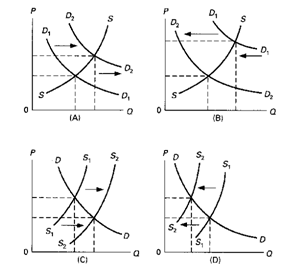
Effect of an increase in the price
Which of the following diagrams depictes(s) the effect of an increase in the price of Budweiser beer on the market for Coors beer? A) A and C. B) A only. C) B only. D) C only. Give me the answer of above question
Which of the following diagrams depictes(s) the effect of an increase in the price of Budweiser beer on the market for Coors beer? A) A and C. B) A only. C) B only. D) C only.
Give me the answer of above question
I have a problem in economics on Problem relating to Taxes and Subsidies. Please help me in the following question. The sales taxes and government subsidies: (1) Influence only demand. (2) Do not influence the supply curve. (3) Affect the supply curve
Can someone help me in finding out the right answer from the given options. The worker who signed a yellow dog contract in the year 1920s agreed: (1) To support the union’s feather-bedding efforts. (2) Not to work with the ‘scab’ non-union strike-bre
I have a problem in economics on Production Costs of goods problem. Please help me in the following question. In order to provide more goods on the market, firms increase prices to cover: (1) Rising opportunity costs in the production. (2) Technologic
Disparities into the relative distributions of two variables can be demonstrated with: (w) Lorenz curves. (x) Friedman curves. (y) Engels curves. (z) Sowell curves. I need a good answer on the topic of Econ
Boosting the price for Pixie’s cheesy fried grits by P2 to P3 will: (w) increases total revenue since demand within inelastic. (x) increase total revenue since demand is elastic. (y) reduce total revenue since demand is inelastic. (z) reduce total revenue since demand
Elucidate briefly the average standard of living in Africa?
For a particular price taker: (w) price is uninfluenced by quantity. (x) total revenue is constant. (y) profit is constant. (z) consumer surplus is zero. I need a good answer on the topic of Economics
Illustrations of price floors comprised: (1) agricultural subsidies upon, for example: corn. (2) usury laws, that are limits on the interest rates on loans. (3) utility rate structures upon natural gas or electricity. (4) rent controls in London, San
When it is illegal to necessitate union membership as a condition of employment for firm, then the firm: (1) Needs all the employees to sign the yellow dog contracts. (2) Can’t sign an agency shop agreement with the union. (3) Can need settlement before workers
An illustration of how marginal utility diminishes takes place when: (1) Todd only requires 180 screws for his bike repair shop however purchases a box of 200 screws. (2) Amy Sue decides she would instead contain 150 hogs than 151 on her pig farm. (3)
18,76,764
1947658 Asked
3,689
Active Tutors
1426897
Questions Answered
Start Excelling in your courses, Ask an Expert and get answers for your homework and assignments!!