--%>

Domestic opportunity cost of production possibilities tables

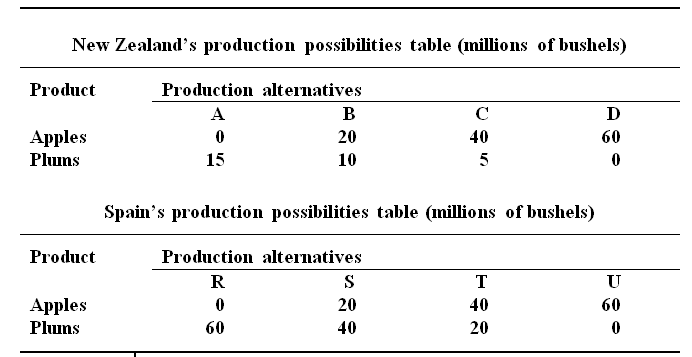
Hypothetical production possibilities tables for New Zealand and Spain are given below
639_Hypothetical production possibilities.png


Employing a graph, draw the production possibilities data for each of the two countries. Referring to graphs, Find out:

(a) Each country's domestic opportunity cost of generating plums and apples.

(b) Which nation has to specialize in which product.

(c) The trading possibilities lines for each of the nation if the real terms of trade are 1 plum for 2 apples.

(d) Profit after trade.


E

Expert

Verified

(a) New Zealand’s cost ratio is 1 plum = 4 apples (or 1 apple = 1/4 plum). Spain’s cost ratio is 1 plum = 1 apple (or 1 apple = 1 plum). Illustrates in the below graphs.

(b) New Zealand has to specialize in apples, Spain in plums.

(c)  The trading possibilities lines for each of the nation if the real terms of trade are 1 plum for 2 apples is described in graph below

(d) Net production before specialization & trade: 40 apples (20 + 20) and 50 plums (10 + 40). After specialization & trade: 60 apples & 60 plums. Gain will be 20 apples and 10 plums.


467_Production possibilities data.png

   Related Questions in Finance Basics

  • Q : Describe the role of a broker in

    Describe the role of a broker within security transactions? How are brokers compensated?Brokers handle orders to purchase or sell securities. Brokers are agents who work in support of an investor. While investors call with an order, brokers work

  • Q : Explain Administratively Established

    Administratively Established Positions: The positions authorized by the Department of Finance throughout a fiscal year that were not comprised in the Budget and are essential for workload or administrative reasons. These positions fin

  • Q : What are Governmental Cost Funds

    Governmental Cost Funds: For lawful basis accounting and budgeting aims, funds which derive revenue from the taxes, licenses, and fees.

  • Q : Chartered bank loan policy Normal 0

    Normal 0 false false

  • Q : Describe difference between business

    Describe difference between business risk and financial risk?Business risk refers to the uncertainty company hold regarding to its operating income (also termed as earnings before interest & taxes or EBIT). Business risk is brought onto sale

  • Q : Describe the financial leverage effect

    Describe the financial leverage effect and what causes it? Explain the potential benefits and negative consequences of high financial leverage? Financial leverage is the additional volatility of overall income caused through the presence of fix

  • Q : Describe the status of cyclically

    Assume the full-employment, non-inflationary level of real output is GDP3 (not GDP2). If the economy is operating at GDP2 instead of GDP3, describe the status of its cyclically adjusted budget? The status of its present fiscal polic

  • Q : What is Workload Budget Adjustment

    Workload Budget Adjustment: Any adjustment to the presently authorized budget obligatory to maintain the level of service needed to fund a Workload Budget, as stated in the Government Code Section 13308.05. A workload budget adjustment is as well term

  • Q : Role of depreciation in estimating

    What kind of role does depreciation play in estimating incremental cash flows? Depreciation expense is a tax deductible expense and therefore affects cash flow through its effect on taxes. Depreciation expense which is incremental to a proposed

  • Q : Describe relationship among a bonds

    Describe relationship among a bond's market price and its promised yield to maturity? Describe.A bond's market price based on its yield to maturity (YTM). While a bond has YTM greater than its coupon rate, it sells at discount from its face va