--%>

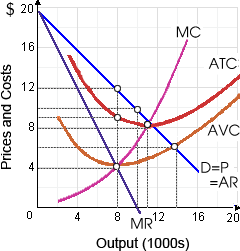
Determine total revenue when maximizes economic profits

Total revenue when this firm maximizes economic profits would be: (w) $72,000 per period. (x) $80,000 per period. (y) $96,000 per period. (z) $100,000 per period.
392_Price Discrimination.png

Can anybody suggest me the proper explanation for given problem regarding Economics generally?

   Related Questions in Microeconomics

  • Q : Changes in dollar receipts from sales

    The change within a firm’s dollar receipts from sales when this produces and sells one additional unit of output is termed as: (w) price. (x) marginal revenue. (y) average revenue. (z) contribution to overhead. Can anybody su

  • Q : Marginal utility of Goods and Bads When

    When Joe Glutton’s final bite of a burger yielded no profit in total utility, then Joe: (i) Don’t like hamburgers. (ii) Has reached the minimum utility from eating the burgers. (iii) Has reached the point where marginal utility of hamburgers is 0 (zero). (

  • Q : Monopsonist-Wage discriminate Compared

    Compared with the price taker in labor market, the monopsonist which can’t wage discriminate will: (i) Hire more labor at any specified wage. (ii) Hire less labor at any wage. (iii) Pay a higher wage for any specified quantity of labor. (iv) Hire more prolific l

  • Q : Profits and losses in long run In the

    In the long run: (i) purely competitive firms make zero economic profits. (ii) monopolistically competitive firms make zero economic profits. (iii) effective barriers to entry may permit economic profits. (iv) oligopolists and monopolists may realize

  • Q : Price discriminate maximizes joint

    When a successful cartel which cannot price discriminate maximizes the joint profits of its members: (1) the marginal social benefits of additional output exceed the marginal social costs of output. (2) this is impossible for any consumer to gain with

  • Q : Negatively-sloped straight line in

    When a demand curve is a negatively-sloped straight line, in that case demand is perfectly: (w) elastic where quantity demanded is zero. (x) elastic where price is zero. (y) inelastic where quantity demanded is zero. (z) elastic or inelastic all over

  • Q : Distribution of Wealth Wealth is

    Wealth is distributed within the United States such as the lowest quintile [20 percent] owns: (w) about 7% of all wealth; where the highest quintile owns 60%. (x) about 5% of all wealth; where the highest quintile has 40%. (y) less than 3% of all wealth; where the ric

  • Q : Problem on Laws and Regulations Can

    Can someone please help me in finding out the accurate answer from the following question. Raised demand for beer would be most probable to follow a fall in the: (1) Legal drinking age. (2) Price of ale. (3) Price of hard liquor. (4) Price of wine.

  • Q : Problem on Product Differentiation Most

    Most of the mass advertising is planned to: (1) Give accurate information on product and price quality. (2) Boost output to conform to the consumer preferences. (3) Alter the consumer preferences. (4) Provide free TV entertainment and remain newspaper

  • Q : Proportion of total costs I have a

    I have a problem in economics on Proportion of total costs. Please help me in the following question. Demand for the labor is more elastic as the: (1) Bigger labor costs is as proportion of net costs. (2) Shorter the time-interval considered. (3) Bigg