--%>

Determine prices by maximize total revenue

LoCalLoCarbo that is Favorite Corporation of fad dieters, which can maximize its total revenue when this produces: (1) output q2 and charges a price equal to P1. (2) output q3 and charges a price of more than P2 although less than P1. (3) output q* and charges a price of more than P2 but less than P1. (4) output q4 and charges a price equal to P2. (5) output q5 and charges a price of more than P3 although less than P2.
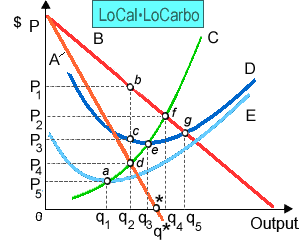
2407_Market Power and Marginal Revenue.png

Can anybody suggest me the proper explanation for given problem regarding Economics generally?

   Related Questions in Microeconomics

  • Q : Characterized purely-competitive markets

    Purely-competitive markets are NOT characterized through: (i) substantial barriers to entry and exit. (ii) many small potential buyers. (iii) many small potential sellers. (iv) homogeneous products. (v) zero long-run economic profits.

    Q : Individual taker in pure competition

    For a particular price taker: (w) price is uninfluenced by quantity. (x) total revenue is constant. (y) profit is constant. (z) consumer surplus is zero. I need a good answer on the topic of Economics

  • Q : Competitive market Select the right

    Select the right answer of the question. A competitive market will: A) achieve an equilibrium price. B) produce shortages. C) produce surpluses. D) create disorder.

  • Q : Amount of output supplied and price

    The amount of output supplied is exactly proportional to the price therefore the price elasticity of supply equivalents one into: (w) Panel A. (x) Panel B. (y) Panel C. (z) Panel D.

    Q : Example to illustrate non-tariff trade

    Imports and American cars are close nevertheless not ideal substitutes. When the U.S. government tried to boost American car sales through setting a price ceiling of P1 upon imported cars in that case: (w) the quantity of cars imported will

  • Q : Influence of good on opportunity cost

    The law of demand defines that, all as well constant, consumers will obtain: (i) More of a good, the lower its opportunity cost. (ii) Less of any good, higher the prices of its substitutes. (iii) Advertised goods more often than generic products. (iv) Greater luxuries

  • Q : Determine price elasticity of demand

    When a $9.98 sale on regular $19.95 watch fobs increases a store's sales from 30 to 300 weekly, the price elasticity of the demand faced through the store is approximately: (w) 2.46. (x) 1.23. (y) 4.92. (z) 0.62. C

  • Q : Minimum wage law for poor workers A

    A minimum wage law does NOT make pressures which tend to: (1) benefit high wage workers. (2) cause unemployment among unskilled workers. (3) uniformly help poor workers. (4) increase teenage unemployment. (5) foster discrimination.

    Q : Relatively inelasticity in supply curve

    At point c, in illustrated figure the supply curve into this graph is: (w) perfectly price elastic. (x) relatively price elastic. (y) unitarily price elastic. (z) relatively inelastic.

    Q : Transitivity Please provide me answer

    Please provide me answer of this question. What will be the implications for consumer's preferences and her indifference curves if the axiom of transitivity does not hold?