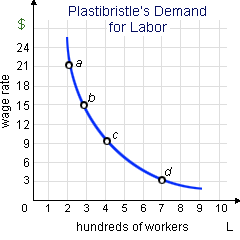
Demand for labor between two points in arc elasticity
The arc elasticity of Plastibristle’s demand for labor between point a and point b is: (1) 0.375. (2) 0.667. (3) 0.833. (4) 1.200 (5) 2.000. Hey friends please give your opinion for the problem of Economics that is given above.
The arc elasticity of Plastibristle’s demand for labor between point a and point b is: (1) 0.375. (2) 0.667. (3) 0.833. (4) 1.200 (5) 2.000.
Hey friends please give your opinion for the problem of Economics that is given above.
Agricultural productivity within Massachusetts Bay Colony increased while Native Americans showed Pilgrims how crops grow faster and better when rotten fish are dropped in along with newly-planted seeds. This new knowledge for the Pilgrims was an illustration of: (1)
Assume that you view a degree as a ticket to a high-paying job along with prospects of quick promotion, and that accumulating human capital by learning and studying valuable material is largely not relevant. Your perception is which a college degree f
What are the important areas of decision-making?
Since an economy moves downward all along the production possibility frontier which is concave from beneath, the: (1) Opportunity cost of the good whose production goes increasing. (2) Law of rising returns outcomes ever lower costs. (3) Dollar value
Cheating on agreements is a common problem along with firms which engage in the formation of: (1) predatory prices. (2) game theory groupings. (3) cartels. (4) pure competition. (5) asymmetric payoffs. Can someone explain/help me w
Define the term opportunity cost concept.
Define the term full cost concept.
Illustrates the criteria for good forecasting method?
Illustrates the terms total cost, average cost and also marginal cost?
Illustrates the role of cost in pricing?
18,76,764
1936519 Asked
3,689
Active Tutors
1443516
Questions Answered
Start Excelling in your courses, Ask an Expert and get answers for your homework and assignments!!