--%>

Define Unions

Unions: Unions in C and C++ are object overlays—aggregate quantities such as structs, except that each element of the union consists offset 0, and the total size of union is only as large as is required to hold its largest member (Kernighan and Ritchie 1998).
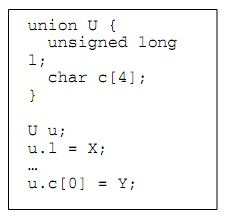
2120_unions.jpg

Unions are not supported by languages like Java. The translation has to generate different objects for the union itself and all its fields, plus the code to keep their values consistent. This results in additional overhead and can increase the state space considerably.

   Related Questions in Programming Languages

  • Q : Explain the term Latest XHTML

    Explain the term Latest XHTML Specification?

  • Q : Simple Sorting Program in C Shell

    Assignment: Sorting You will write a simple sorting program. This program should be invoked as follows: shell% ./fastsort -i inputfile -o outputfile

  • Q : Define several features of XQuery

    Define several features of XQuery?

  • Q : Explain Aggregation Aggregation : It is

    Aggregation: It is a relationship in which an object has one or more other subordinate objects as portion of its state. The subordinate objects usually have no self-governing existence separate from their containing object. Whenever the containing obj

  • Q : Define the term Direct recursion Define

    Define the term Direct recursion: Recursion which outcomes from a method of calling itself.

  • Q : How is an external entity reference

    While constructing an XML DTD, how do you make an external entity reference within an attribute value?

  • Q : Explain Object reference Object

    Object reference: It is a reference to an object. Languages other than Java employ terms like pointer or address or. It is significant to keep the difference clear between an object and its reference. The variable like argo

    Q : State the term XLL State the term XLL?

    State the term XLL? Answer: The specification of XML Link Language has XPointer or XLink.

  • Q : What is Binary operator Binary operator

    Binary operator: It is an operator taking two operands. Java has numerous binary operators, like the arithmetic operators +, -, *, / and %, and the Boolean operators &&, || and ^, among others.

  • Q : Explain Branch instruction Branch

    Branch instruction: It stores a new instruction address into the program counter. The consequence of this is the next instruction to be fetched will not generally be the one instantly following the branch instruction. Therefore the normal chronologica