--%>

Define Unconditional Jumps

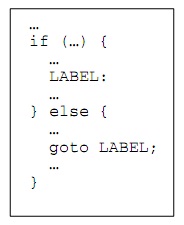
Unconditional Jumps: Jumps which are not strictly upwards in the block hierarchy can require extensive control-flow manipulation, including creation of redundant code, and should be avoided if possible. Such jumps add considerable modeling overhead for some model checkers. For example, gotos are not directly supported in JPF, but SPIN does handle them by default:
2463_unconditional jum.jpg

   Related Questions in Programming Languages

  • Q : Procedural and object-oriented programs

    Illustrate the difference between the procedural and object-oriented programs in brief.

  • Q : Explain the term Portable Portable :

    Portable: The Portability is the quality of a program which makes it probable to run it on different kinds of computers. The programs written in low level languages are usually not very portable since they are generally closely tied to a particular in

  • Q : Write a recursive function intpower(base

    Write a recursive function intpower(base, exponent) that when invoked returns base^exponent. For example, intpower(3,4) = 3*3*3*3. Assume that the exponent is an integer greater than or equal to 1.

  • Q : What is no-arg constructor no-arg

    no-arg constructor: It is a constructor which takes no arguments. By default, each and every class without an explicit constructor has a default no-arg constructor with the public access. Its role is entirely to invoke the no-arg constructor of the in

  • Q : What is Abstract method Abstract method

    Abstract method: This is a method with the abstract reserved word in its header. The abstract method has no method body. Methods stated in an interface are for all time abstract. The body of an abstract method should be stated in a su

  • Q : Define the term Boolean Boolean : It is

    Boolean: It is one of the Java's primitive types. The Boolean type has merely two values: true and false.

  • Q : State the term URL path State the term

    State the term URL path?

  • Q : Explain Aggregation Aggregation : It is

    Aggregation: It is a relationship in which an object has one or more other subordinate objects as portion of its state. The subordinate objects usually have no self-governing existence separate from their containing object. Whenever the containing obj

  • Q : Define Constant Constant : It is the

    Constant: It is the memory block where value can be stored once although can’t modify later on throughout program execution. Example: const int pi =3.14;

  • Q : What is the way to use XForms What is

    What is the way to use XForms?