--%>

Decreases in market demand of profit-maximizing output

Decreased market demand for generic bricks would result in a(n) ___________ in the price of bricks and a(n) ___________ in this brickyard’s profit-maximizing output. (w) increase; decrease. (x) increase; increase. (y) decrease; decrease. (z) decrease; increase.
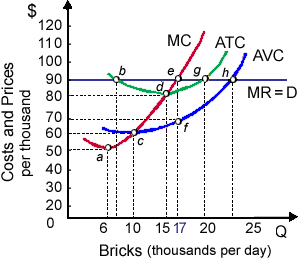
1366_Profit Maximization1.png

Hey friends please give your opinion for the problem of Economics that is given above.

   Related Questions in Microeconomics

  • Q : Minimum Wage Laws I have a problem in

    I have a problem in economics on Minimum Wage Laws. Please help me in the following question. Minimum wage legislation has been promotes as a technique to: (i) Make sure that workers are paid beneath the subsistence salaries. (ii)  Perpetuate poverty. (iii) Maxim

  • Q : Emerging natural monopoly A monopoly

    A monopoly will come out naturally when: (w) the government relaxes antitrust laws. (x) economies of scale are large relative to market demand. (y) variable costs are huge relative to fixed costs. (z) variable costs rise as output expands.

  • Q : Define Ex-ante aggregate demand Define

    Define Ex-ante aggregate demand: This is planned or the desired aggregate demand.

  • Q : Price elasticity of demand when price

    When diet faddists gulp 205 million unsweetened as “No-Carb” milkshakes of $2.30 apiece, if cut back to 155 million per week while the price rises to $3.70 every, the price elasticity of their demand for shakes equivalents

  • Q : Principle of equal marginal utilities

    The thought that, in equilibrium, the more you pay for the good, more it is worth (that is, at the margin) to you is most intimately associated to the: (1) Law of diminishing returns. (2) Equivalent satisfaction corollary. (3) Veblen effect. (4) Rising cost hypothesis

  • Q : Determine average production cost by an

    When Robomatic Corporation maximizes profit in its production of RoboMaids, its average production cost per robot will be roughly: (1) $3,000 per robot. (2) $5,000 per robot. (3) $7,000 per robot. (4) $9,000 per robot. (5) $11,000 per robot.

  • Q : Maximize profit by monopolistic

    Monopolistic competitors maximize profit through: (w) adjusting output at a given price. (x) adjusting price for a given output. (y) adjusting output and price. (z) cheating. Can someone explain/help me with best s

  • Q : Transfer payment by excesses income A

    A person’s wage income into excess of which that would be received by accepting the next best optional use of his or her talents is: (1) an economic rent. (2) a transfer payment. (3) an interest premium. (4) a salary bonus. (5) nominal wages.

  • Q : Opportunity Cost to the User An

    An opportunity cost to the user, although not to society as an entire, which would be the: (w) accounting profits realized by a firm of CPAs. (x) interest paid by a borrower for a bank loan. (y) rent paid by a sharecropper to a plantation owner. (z) m

  • Q : Determinants of the amounts of a good

    Economics students are most probable to recall conceptually the different determinants of the amounts of a good which people will purchase when they contemplate how: (1) much they will expend and how much they will save out of their first few paycheck