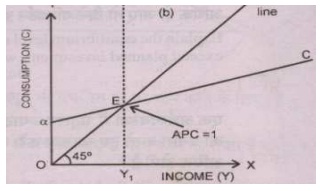
Consumption curve
Illustrate a point on consumption curve at which APC = 1. Answer: APC = C/Y = 1 is possible when C = Y, that is, Consumption is equivalent to Income.
Illustrate a point on consumption curve at which APC = 1.
Answer:
APC = C/Y = 1 is possible when C = Y, that is, Consumption is equivalent to Income.
Why is recovery of loans taken as a capital receipt? Answer: Recovery of loans is always treated as a capital receipt since it leads to refuse in financial assets o
‘Over the precedent 30 years, and particularly as our entry into the EU, imports (and exports) as a proportion of GDP have increases considerably in the UK. What influence has this had on the value of multiplier in the UK?’
How does the FED utilize the bond market to make and destroy money? Which technique do developed countries utilize to decrease the chance of experiencing inflation? What about the Banana Republicans and inflation, do they have this means acessible to
State the Law of supply and explain the factors that affecting supply of commodity
DISCUSS the experience of high GNP countries and low GNP with regard to PQLI.
Implications of fiscal deficit: (A) High fiscal deficit entails a big amount of borrowings in which the government takes more loans to pay back it. It raises the liability of government. Q : Important issues in Macroeconomics to Macroeconomics is primarily focused on issues about: (w) economy extensive aggregate variables as like national income. (x) the structure of economic activity quite than its level. (y) resource allocations through households and business firms. (z) po
Macroeconomics is primarily focused on issues about: (w) economy extensive aggregate variables as like national income. (x) the structure of economic activity quite than its level. (y) resource allocations through households and business firms. (z) po
From the heterodox approach, what options does the enterprise have to produce more output? What impact do these options have on its cost structure?
What is Demand schedule and how it is associated to demand curve?
Evaluate the value of fiscal deficit when primary deficit is 53,000 crores and interest on borrowings is Rs 5,000 crores?
18,76,764
1939676 Asked
3,689
Active Tutors
1446182
Questions Answered
Start Excelling in your courses, Ask an Expert and get answers for your homework and assignments!!