--%>

Constant cost industry in competitive processes

When brick-making is a constant cost industry, during the long run this firm is probable to experience: (i) a severe shrinking of economic profit to zero. (ii) a decline in the price of bricks to approximately eight cents apiece. (iii) increased competition as new firms enter the brick-making industry.  (iv) a reduction in the brickyard’s equilibrium output. (v) All of the above.
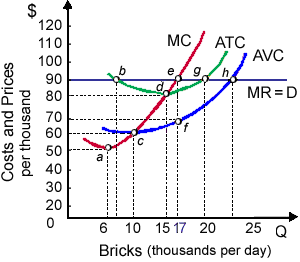
2111_Profit Maximization1.png

I need a good answer on the topic of Economics problems. Please give me your suggestion for the same by using above options.

   Related Questions in Microeconomics

  • Q : Complementary goods problem When a

    When a price cut for licorice gummy bears decreases the demand for tuna fish ice cream, then: (i) tuna fish ice cream and licorice gummy bears are both complementary goods. (ii) Price scrambles for tuna fish ice cream will diminish the demand for licorice gummy bears.

  • Q : Scope of spiral and waterfall approach

    Explain the difference in changing the scope between a spiral approach and a waterfall approach?

  • Q : Complementary Goods-Increasing prices

    When the price of hot dogs rises, you would suppose the demand for: (i) mustard to rise. (ii) Hot dogs to reduce. (iii) Buns to rise. (iv) Hot dogs to rise. (v) Buns to reduce. Find out the right answer from the above options.

  • Q : Problem on substitution effect The

    The substitution effect is the modification in purchases of a good which outcome from a change only in: (1) Tastes and preferences. (2) Its associative price. (3) Real national income. (4) The wealth of consumer. P

  • Q : Quantity supplied to relative change in

    The price elasticity of supply approximately measures the ratio of relative as: (w) profit to the amounts firms supply at different prices. (x) price increase necessary to induce a firm to raise output. (y) change within the quantity supplied to a rel

  • Q : Goals of Firm-Standard economic

    Can someone please help me in finding out the precise answer from the following question. The standard economic assumption which firms attempt to maximize the profit: (i) Is the beginning point for most of the economists’ analyses of how to operate firms. (ii) C

  • Q : Problem on least monopsony power The

    The Firms which have at least some monopsony power will never: (i) Practice wage discrimination. (ii) Find out wage rates in portion by the number of workers it hires. (iii) Pay higher wages than would a firm hiring from the competitive labor market. (iv) Raise the em

  • Q : Effects of marginal utility on Consumer

    Can someone please help me in finding out the accurate answer from the following question. When your marginal utility from $5 movies averages 50 utils and your marginal utility from $2 gallons of the gasoline is 20 utils, you can: (1) Not add to your satisfaction by m

  • Q : Featherbedding in its hiring practices

    The summation of monopolistic exploitation across all the workers tends to raise however a firm as well operates at a more socially and economically proficient level of output and employment whenever the firm is capable to engage in: (1) Blacklisting in its dealings t

  • Q : Higher interest rate in funds A higher

    A higher interest rate is probably to be a consequence of: (1) lower expected profitability to investors. (2) new tax breaks onto interest income. (3) weakening preferences for current income over future income. (4) increased preferences for recent co