--%>

Competitive Prices for selling

This purely-competitive producer’s generic bricks presently sell for: (i) $60 per thousand. (ii) $70 per thousand. (iii) $80 per thousand. (iv) $90 per thousand. (v) $100 per thousand.
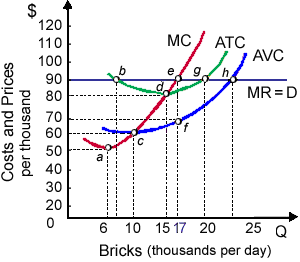
595_Profit Maximization1.png

Hello guys I want your advice. Please recommend some views for above Economics problems.

   Related Questions in Microeconomics

  • Q : Implication of price discrimination

    Price discrimination implies: (1) charging different prices for identical goods that have identical production costs. (2) paying wages based on race or sex quite than productivity. (3) exploiting the working masses by charging the highest single price

  • Q : Monopolistic Exploitation Can someone

    Can someone help me in finding out the right answer from the given options. In the equilibrium for a price maker firm, the rate of monopolistic exploitation is any difference among: (i) P and MR. (ii) P and MC. (iii) VMP and MRP. (iv) Output price and rate of monopson

  • Q : Malthusian theory on population What do

    What do you mean by the Malthusian theory on population?

  • Q : Problem on market demand for toys

    Booming toy sales throughout December usually reflect rises in: (1) The quantity of toys demanded.  (2) Market demand for toys. (3) Production costs. (4) Infantile consumerism. Can someone please help me in finding out the acc

  • Q : Exhibiting Predatory Behavior If a firm

    If a firm attempts to drive rivals from its market and after that raises prices and adopts a strategy to deter entry, this is exhibiting: (w) grim strategy. (x) tit-for-tat strategy. (y) predatory behavior. (z) Nash equilibrium.

    Q : Quantity supplied to relative change in

    The price elasticity of supply approximately measures the ratio of relative as: (w) profit to the amounts firms supply at different prices. (x) price increase necessary to induce a firm to raise output. (y) change within the quantity supplied to a rel

  • Q : What is demand schedule Demand schedule

    Demand schedule: This is a tabular symbolization of different quantities demanded at various levels of prices.

  • Q : Backward bending-supply curve of labor

    Supply curve of the labor is LEAST probable to be ‘backward bending’ for: (i) An individual worker. (ii) The economy as an entire. (iii) Highly specialized industries which are major employers of the specialized PhDs hired only after 10 years of experience

  • Q : Ex-ante investment Ex-ante investment :

    Ex-ante investment: This is planned or desired investment throughout a specific period.

  • Q : Buying and selling cost in monetary

    Additionally to monetary prices, there the costs of buying and selling comprise: (w) wage payments. (x) monopoly profits. (y) transaction costs. (z) social benefits. How can I solve my economics pr