--%>

Charging price of profit-maximizing monopolist

Hybrid Roses is the merely florist in 60 miles of Presidio, Texas. When total fixed costs (for example, rent and utilities) are $9 per hour, that profit-maximizing monopolist will charge a price of: (1) $10 per dozen roses. (2) $12 per dozen roses. (3) $14 per dozen roses. (4) $16 per dozen roses. (5) $18 per dozen roses.
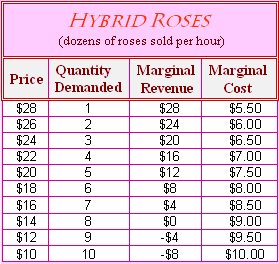
1002_Maximum Total Revenue.png

I need a good answer on the topic of Economics problems. Please give me your suggestion for the same by using above options.

   Related Questions in Microeconomics

  • Q : Determine price when quantity demand

    If the demand for a good is price elastic, in that case the percentage change in quantity demanded into response to a specified change within price is: (1) greater than the percentage change in price. (2) positively related to the cha

  • Q : Problem of Nash Equilibrium Carlos and

    Carlos and Ivana are room-mates and friends. Carlos and Ivana eat together despite who cooks on a given night. Within this payoff matrix, Nash equilibrium could never be obtained in that: (w) neither Carlos nor Ivana cook, nor do they eat. (x) Carlos

  • Q : Normal accounting profits I have a

    I have a problem in economics on Normal accounting profits. Please help me in the following question. The normal accounting profits are considered by the economists to be: (i) Exploitation of the consumer. (ii) Evidence of monopoly power. (iii) Economic costs of the p

  • Q : Monopoly market structure When one firm

    When one firm controls all production and the price of a good without shut substitutes, there is: (i) monopoly market structure. (ii) violation of the law of demand and supply. (iii) lack of equity although assurance of efficiency. (iv) legal barrier to entry. (v) cer

  • Q : Characterization of markets Each and

    Each and every market is characterized by: (i) Widespread advertising, marketing, and sales promotions. (ii) Demands from each and every individual for all products. (iii) Potential buyers ready to pay and potential sellers ready to supply. (iv) Government licenses pr

  • Q : Process of Privatization The

    The Privatization is a process by which ‘for-profit’ business firms: (1) Transform small entrepreneurships into big corporations. (2) Hiring professional administrators to assist manage operations. (3) Vend corporate stocks and bonds to safe the economic c

  • Q : Effects of higher real interest rates

    Higher real interest rates give in: (w) greater incentives to save and decreased incentives to invest. (x) increases in the amount of liquidity desired by financial investors. (y) increases in the optimal debt-equity ratio of a corporation. (z) decrea

  • Q : Problem regarding analyzing persistent

    In analyzing persistent shortages within the U.S. market for adoptable children: (w) children are most reasonably considered investment goods. (x) children might reasonably be functioned as consumer goods. (y) lower prices charged adopting families would result within

  • Q : Profit for purely competitive firms in

    Profit for purely competitive firms tends in the direction of zero in the long run since: (w) managers resist charging more than a fair price. (x) firms collude to charge prices which barely cover average costs. (y) profit attracts entry, whereas loss

  • Q : MOST Negative Liquidity An asset's

    An asset's liquidity is, by description, MOST negatively associated to the: (1) asset's suitability as a commodity money. (2) transaction costs incurred in its purchase or sale. (3) speed with which that can be sold. (4) certainty about its market pri