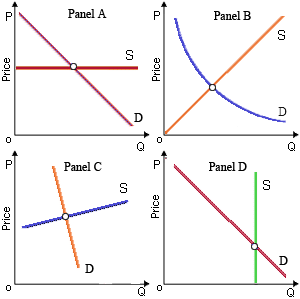
Burden of tax reduce solely on suppliers of the good
The burden of an excise (i.e., per unit) tax would reduce solely upon suppliers of the taxed good within: (w) Panel A. (x) Panel B. (y) Panel C. (z) Panel D. How can I solve my Economics problem? Please suggest me the correct answer.
The burden of an excise (i.e., per unit) tax would reduce solely upon suppliers of the taxed good within: (w) Panel A. (x) Panel B. (y) Panel C. (z) Panel D.
How can I solve my Economics problem? Please suggest me the correct answer.
When the price elasticity of demand for fried cheesy grits at Pixie’s Breakfast Grill is two, in that case a price cut of $2.80 to $2.00 per serving of grits would be most probably to: (1) reduce Pixie’s revenues from grits by roughly fort
When the market price is lower to cover average total costs, in that case a profit-maximizing firm will: (i) shut down instantly. (ii) continue to operate where P = MC when P > AVC. (iii) adopt newer technology. (i
The capability of otherwise skilled workers to engage in specific careers or enter some professions is most likely most inhibited by: (1) Occupational licensing. (2) Wage discrimination. (3) Segregation in school system. (4) Signaling and screening. (5) Union labor co
Budget line: This refers to all combinations of goods that a consumer can purchase with his whole income and price of two goods.
The economies of scale exist whenever average production costs: (1) Increase as the level of output increases. (2) Drop as the level of output increases. (3) Stay similar as the level of output increases. (4) Drop as the level of output drops. Q : Average revenue and marginal revenue In spite of of the amount sold, price equals for a price-taker firm on both average: (i) revenue and marginal revenue. (ii) variable cost and marginal cost. (iii) fixed cost and average variable cost. (iv) total cost and marginal revenue.
In spite of of the amount sold, price equals for a price-taker firm on both average: (i) revenue and marginal revenue. (ii) variable cost and marginal cost. (iii) fixed cost and average variable cost. (iv) total cost and marginal revenue.
The social goal of providing the biggest happiness to the most people is intent to practice the: (i) Precautionary discretion. (ii) Classical theory. (iii) Utilitarianism. (iv) Speculative balances. (v) Arbitrage. Can someone pleas
This profit-maximizing pure competitor would close down within the short run when the price fell below the price resultant to: (i) point c. (ii) point d. (iii) point e. (iv) point f. (v) point g. Q : Price of Bond by Perpetuity When all When all bonds are perpetuities which annually pay $100, at an interest rate of 2%, in that case the price of these bonds would be: (1) $9800. (2) $5000. (3) $980. (4) $800. (5) $1,020. How can I s
When all bonds are perpetuities which annually pay $100, at an interest rate of 2%, in that case the price of these bonds would be: (1) $9800. (2) $5000. (3) $980. (4) $800. (5) $1,020. How can I s
Hulk is the fitness counselor who coaches 5 clients at a time in the exercise groups at Beefcake Body Builders. His hourly salary is $17, and Beefcake charges Hulk’s clients $20 for each and every hour-long conditioning session. Average value of the product Hulk
18,76,764
1922512 Asked
3,689
Active Tutors
1436626
Questions Answered
Start Excelling in your courses, Ask an Expert and get answers for your homework and assignments!!