--%>

Budget line and indifference curves

Question:

Monica has been considering buying a mountain bike. Last month Monica had an income of $30,000. The bike's price was $1000, the composite good price was $1, and she decided not to buy the bike.  This month Monica was surprised to get a $10,000 increase in income. The prices of the bike and the composite good are the same, but now Monica decides to buy the bike. Draw a budget line and indifference curves to illustrate this situation. Be sure to label you diagram completely. 

Solution:

Income, m = $30,000, Pb = $1000, Pc = $1

Where, Pb = price of bike.

             Pc = price of composite goods

Therefore, Budget equation is:

c + Pb b = 30000

  1.   c = 30000 - Pb b
  2.   c = 30000 - 1000b

Therefore, putting c on vertical axis, the slope is -1000

Also, vertical intercept = 30000/1 = 30000

         Horizontal intercept = 30000/1000 = 30

The new income = $40,000

Therefore, Budget equation is:

c + Pb b = 40000

  1.   c = 40000 - Pb b
  2.   c = 40000 - 1000b

Therefore, putting c on vertical axis, the slope is -1000

Also, vertical intercept = 40000/1 = 40000

         Horizontal intercept = 40000/1000 = 40
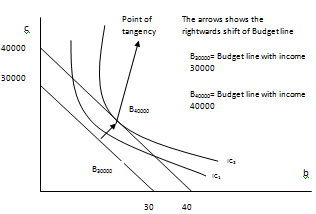
690_budget line and indifference curves.png

   Related Questions in Business Economics

  • Q : International trade to the U.S. economy

    How important is international trade to the U.S. economy?  In terms of volume, does the United States trade more with industrially advanced economies or with developing economies? What country is the United States’ most important trading partner, quantitati

  • Q : Banking crisis on checkable deposits

    Question: Some developing countries have suffered banking crises in which depositors lost part or all of their deposits (in some countries there is no deposit insurance). This type of crisis decreases depositors' confidence in the banking syst

  • Q : Illustrate Scarcity and choice of

    Illustrate Scarcity and choice of Economic Perspective?

  • Q : Fixed costs and Variable cost

    Questions: 1: Which of the following are likely to be fixed costs and which variable costs for a chocolate factory over the course of a month?  Explain your choice.

    Q : Circular flow model of the private

    I have a problem in economics on Circular flow model of the private sector. Please help me in the following question. The simple circular flow model of private sector doesn’t comprise: (i) Firms. (ii) Product markets. (iii) Government agencies.

  • Q : Individual sellers and buyers in

    Both individual sellers and buyers within perfect competition: w) can affect the market price through their own individual actions. x) can affect the market price by joining along with some of their competitors.  y) have to take the market price as a specified. z

  • Q : Best alternatives while choices are made

    Opportunity costs, which are the values of the: (i) monetary costs of goods and services. (ii) best alternatives sacrificed while choices are made. (iii) minimal budgets of families upon welfare. (iv) hidden charges passed upon to consumers. (v) exorb

  • Q : Illustrate the changes in Demand

    Illustrate the changes in Demand, Supply and Equilibrium?

  • Q : Entrepreneurs and business are at the

    Explain the statements: Entrepreneurs and business are at the helm of the economy.

  • Q : Describe unequal burdens of

    Describe unequal burdens of unemployment exist?