--%>

Break even and zero economic profit

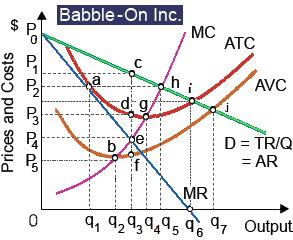
After Babble-On’s patents lapsed and entry and exit turned into possible in this illustrated figure of market, in the long run Babble-On would be expected to: (i) continue to reap economic profits. (ii) break even and experience zero economic profit. (iii) have zero accounting profit. (iv) operate at inefficiently low levels of output. (v) raise the price of its software.
128_Market Power.png

Can someone explain/help me with best solution about problem of Economics...

   Related Questions in Microeconomics

  • Q : Problem of tax on a good I have a

    I have a problem in economics on Problem of tax on a good. Please help me in the following question. The tax on a good tends to form: (1) A wedge between the price buyers pay and the price sellers collect. (2) Rises in supply from the perspectives of buyers. (3) More

  • Q : Consumer Surplus-Difference in amounts

    Kiley pays $1.00 for the cold Pepsi on a hot afternoon, however would be willing to pay $5.00. The $4.00 difference in such amounts is her: (i) Consumer surplus. (ii) Income effect. (iii) Economic gain. (iv) Marginal utility. (v) Pleasure coefficient.

    Q : Lowest possible price in transaction

    Is the assertion such that "Everyone all the time buys everything at the lowest possible price" right? Have you paid more than you had to for any good yet, after permitting for all transaction costs?

  • Q : Interest rate falls by liquidity When

    When households shift by an emphasis on cash into their portfolios and more stocks and bonds since they have become more willing to hold less liquid assets, in that case the: (w) interest rate rises. (x) present value of future income falls. (y) inter

  • Q : Problem on Equilibrium condition

    Reduction in the size of average American family is most probable to: (i) Erode rates of the technological advancement. (ii) Raise the demand for disposable diapers. (iii) Decrease women’s labor force participation rates. (iv) Increase the contribution of family

  • Q : Profit for purely competitive firms in

    Profit for purely competitive firms tends in the direction of zero in the long run since: (w) managers resist charging more than a fair price. (x) firms collude to charge prices which barely cover average costs. (y) profit attracts entry, whereas loss

  • Q : Distribution of income-inequitable

    Reliance on private demands and supplies to allocate resources and goods is least specific to yield an economically inefficient solution when: (i) producers have significant monopoly power. (ii) a good is nonrival and

  • Q : Problem on Labor Unions and Wages The

    The Industrial unions try to accomplish wage rates above the competitive level through: (i) Limiting the supply of labor to the industry. (ii) Raising the supply of labor. (iii) Raising the productivity of the labor in an industry. (iv) Member’s agreeing to work

  • Q : Define marginal cost Marginal cost : It

    Marginal cost: It is the change in sum cost by generating one more or less unit of output.

  • Q : Poverty by throughout lives Which of

    Which of the given statements is not correct? (w) Wealth is less equally distributed than income. (x) U.S. tax and transfer programs tend to make income more evenly distributed. (y) Some disincentives for work plague even the most efficient of proposed welfare reforms