--%>

Average variable costs and average total costs

Both average variable costs and average total costs are demonstrated for this profit-maximizing firm, therefore this given figure depicts information for: (i) an oligopoly firm. (ii) operations in the short run since fixed costs are present, although we can also infer which this firm is in long run equilibrium since this is generating zero economic profits. (iii) a monopolistic competitor. (iv) a pure competitor in the output market along with some market power while buying resources. (v) a pure monopoly.
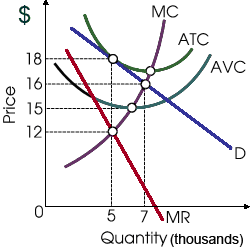
1648_Monopolistic Competition1.png

How can I solve my Economics problem? Please suggest me the correct answer.

   Related Questions in Microeconomics

  • Q : Automation process I have a problem in

    I have a problem in economics on Automation process. Please help me in the following question. The procedure of substituting complicated machinery for human labor is termed as: (1) automation. (2) Bionic engineering. (3) Robotics. (4) Scientific manag

  • Q : Efficiency Wages-Expected losses

    Expected losses to the workers from shirking are raised when a firm accepts a policy of: (1) Dividing the productive tasks and hence the division of labor is optimal. (2) Paying the efficiency wages which surpass market-clearing wages. (3) Avoiding the legal liability

  • Q : Distorted competitive workings of the

    The competitive workings of the market for soy beans would be distorted when: (1) Europe experiences a severe drought and has paltry harvests this year. (2) Ethiopia imports soy beans to feed its hungry masses. (3) the U.S. imposes a soy bean embargo forbidding export

  • Q : Exploitation of Labor-average revenue

    The Exploitation might not exist even when the wage a worker is paid is less than worker’s: (1) Average revenue product. (2) Marginal revenue product. (3) Marginal factor cost. (4) The value of marginal product. Can someone p

  • Q : Decision processes in Microeconomics

    Decision processes within households, and government and firms and the consequences of such decisions are initially the focus of: (1) positive economics. (2) public choice economics. (3) microeconomics. (4) normative economics. (5) microeconomics.

  • Q : Problem on least monopsony power The

    The Firms which have at least some monopsony power will never: (i) Practice wage discrimination. (ii) Find out wage rates in portion by the number of workers it hires. (iii) Pay higher wages than would a firm hiring from the competitive labor market. (iv) Raise the em

  • Q : Uses for break-even analysis Explain

    Explain what are the several uses for break-even analysis?

  • Q : Quantity supply or demand to changes in

    When a measure of the responsiveness of one variable to other (for example, quantity supplied [or demanded] to changes within price), elasticity: (w) provides no criterion for identifying responsiveness. (x) depends on the units used to express change

  • Q : Monopsony Power and the Demand for Labor

    Can someone help me in finding out the right answer from the given options. The labor monopsonist will hire labor up to a point where marginal: (1) Revenue product of the labor equivalents the wage. (2) Resource cost of labor equivalents the wage. (3) Revenue product

  • Q : Problem on opportunity cost of consumer

    Refer to the given table. If the economy is producing at production alternative C, the opportunity cost of the tenth unit of consumer goods will be: