--%>

Average retail price and the consumer Price Index

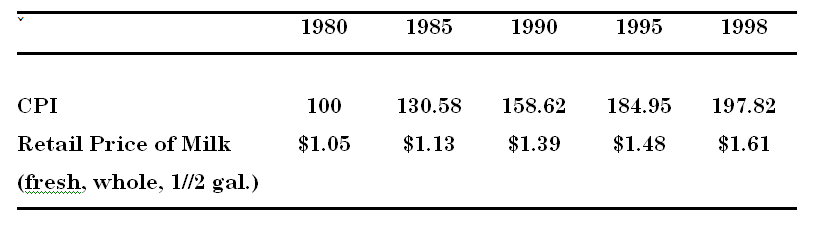
Table illustrates the average retail price of milk and the Consumer Price Index from the year 1980 to 1998.
42_Average retail price and the consumer Price Index.png

Compute the real price of milk in the year 1980 dollars. Has the real price increased/decreased/stayed the similar since the year 1980?
Real price of milk in year X =CPI1980 /CPI year X nominal price in year 1980

                    1980 $1.05        1985 $0.86            1990 $0.88     1995 $0.80  1998 $0.81

Since 1980 the real price of milk has reduced.


   Related Questions in Microeconomics

  • Q : Define equilibrium price Equilibrium

    Equilibrium price: The Equilibrium price refers to a price at which the market demand and market supply are equivalent.

  • Q : Collective Bargaining-John Hicks model

    I have a problem in economics on Collective Bargaining-John Hicks model. Please help me in the following question. Sir John Hick’s model of the collective bargaining doesn’t describe: (1) Final wage settlements. (2) The period of strikes.

  • Q : Price elasticity of supply while the

    If John Whittler can sell totem poles for $1,800 at all, he markets 60 yearly, but while the price falls to $600 apiece; in that case he is willing to sell only 24 yearly. His price elasticity of supply is: (w) 0.43. (x) 0.86. (y) 1.62. (z) 2.48.

  • Q : Maximum total revenue for elasticity of

    The elasticity of demand equals one and consumer spending upon Robot Butlers (there is the firm’s total revenue), is at a maximum at a price of as: (1) $20,000. (2) $15,000. (3) $10,000. (4) $5,000. (5) zero.

    Q : Labor market-Monopsony power Can

    Can someone please help me in finding out the accurate answer from the following question. The firm probable to encompass significant monopsony power in its labor market would be: (1) Big cotton farm in the Texas hiring migrant workers. (2) Textile manufacturer in Hon

  • Q : Maximizes profits when price equal to

    A purely competitive firm will turn out where P = MC since this: (w) is good for society. (x) is all which is permitted through law. (y) maximizes profits. (z) permits price adjustment although not quantity adjustment.

    Q : Diminishing Marginal Utility of a good

    Whenever eating a whole pizza and realizing that the last piece didn’t taste almost as good as the first, you are experiencing is: (1) Diminishing the marginal utility. (2) Law of comparative advantage. (3) Law of income effect. (4) Law of supply.

  • Q : Consumer Equilibrium-Utility

    Assume that you are an avid golfer and profit $36 worth of pleasure from the first golf hole played on any specific day, however the additional pleasure you profit from playing succeeding holes falls by $2 per extra hole. The $40 greens fee is needed to begin golfing

  • Q : Statement of Law of Demand The law of

    The law of demand defines that when a good’s price increases, its quantity demanded will drop: (1) No matter what occurs to other variables. (2) When all as well is supposed constant. (3) Since its demand curve shrinks. (4) If substitutes become

  • Q : Public policies to protect by limiting

    The government breakup of AT and T within various regional telephone companies and deregulating long distance services are illustrations of government: (w) enforcement of company size ceiling regulations. (x) creation of monopoly powers. (y) trying to