--%>

Analytic time in market structure


In this figure the firm probably to go out of business the soonest would be as: (w) Firm A. (x) Firm B. (y) Firm C. (z) Firm D.
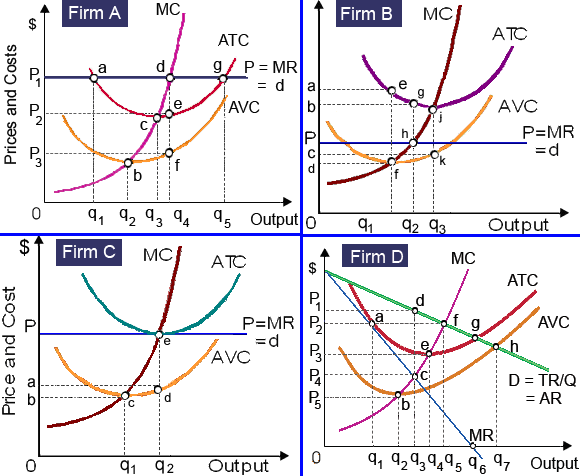
298_Market Structures.png

I need a good answer on the topic of Economics problems. Please give me your suggestion for the same by using above options.

   Related Questions in Microeconomics

  • Q : About greatest economy Does Europe and-

    Does Europe and- USA or China have the greatest economy?

  • Q : Elimination of discrimination In the

    In the following diagram, the elimination of discrimination is best depicted by: 1) a move from C to E. 2) an inward shift of the production possibilities curve. 3) a move from A to D. 4) a move from E to C.

    Q : Collective Bargaining-John Hicks model

    I have a problem in economics on Collective Bargaining-John Hicks model. Please help me in the following question. Sir John Hick’s model of the collective bargaining doesn’t describe: (1) Final wage settlements. (2) The period of strikes.

  • Q : Tax onto the mathematically impaired By

    By the opinion of public finance economists and financial analysts that the label “a tax onto the mathematically impaired” is most likely most applicable to: (1) land taxes. (2) income taxes. (3) inheritance taxes. (4) purchases of lottery

  • Q : Drop in interest rates of capital market

    Any drop in interest rates caused through people’s increased willingness to save, which will cause: (w) the rate of return schedule reflected in I0 to shift to the right. (x) the rate of return schedule reflected within I0 to shift to the left.

  • Q : Quintile distribution of income Give

    Give the answer of following question. In the quintile distribution of income, the term "quintile" represents: A) 5 percent of the income receivers. B) 10 percent of the income receivers. C) 20 percent of the income receivers. D) 25 percent of the income receivers.

  • Q : Area of Loren Curve This function as in

    This function as in illustrated figure area between A and B is termed as a/an: (1) index of inequality. (2) Lorenz curve. (3) Pareto indicator. (4) Gini coefficient. (5) Marx-Engels curve.

    Q : Low-income elasticities of demand

    Placing an excise tax upon goods along with low-income elasticities of demand will share out the tax burden as: (1) proportionally between high-income and low-income households. (2) disproportionately on high-income households. (3) disproportionately

  • Q : On which point demand appears to be

    On this demonstrated figure of demand curve for DVD games, demand appears to be approximately unitarily elastic at: (w) Q = O, P = $50. (x) Q = 10, P = $O. (y) Q = 5, P = $25. (z) No point on the demand curve.

    Q : Characteristics of a purely competitive

    NOT between characteristics of a purely competitive industry would be as: (w) large numbers of potential buyers and sellers. (x) long-run freedom of entry and exit. (y) modern technology that dictates large firms. (z) buyers have no influence on price