Problem on independent gibbs samples
Solve the following problem:
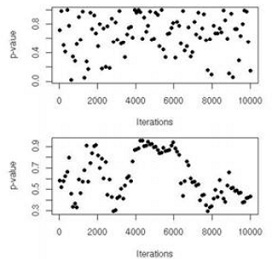
Reproduce Figure for two independent Gibbs samples of size 105, and evaluate the impact of the lag G on the shape of those graphs. (Try G = 2, 5, 10, 100, 1000.)
Expected delivery within 24 Hours
This is a sequential graph in that each dot is based on the sample of ß(t)'s produced at time T and then thinned by a lag of G = 10 and separated.
Explain why sunk costs should not be included in a capital budgeting analysis, but opportunity costs and externalities should be included.
McGregor requires a 12 percent return on its investments. What is the expected NPV of the diet scotch?
If the discount rate for this project is 10 percent, what is the project's NPV?
Evaluate the impact of the lag G on the shape of those graphs. (Try G = 2, 5, 10, 100, 1000.)
Prepare a schedule showing the allocation of service department costs to other departments.
Should the firm under-take the project? Repeat the analysis for discount rates of 2 % and 11 %.
For Z ~ N (0, 1) with truncation (i) -1 3, generate 1000 random variables and compare the histograms with the density functions.
What is the NPV break-even level of sales assuming a tax rate of 35 percent, a 10-year project life, and a discount rate of 12 percent?
1956787
Questions Asked
3,689
Active Tutors
1425370
Questions Answered
Start Excelling in your courses, Ask a tutor for help and get answers for your problems !!
Problem: Developmental Assessments Cognitive Tests: Assessments like the Wechsler Intelligence Scale for Children (WISC)
Behavioral Checklists and Rating Scales Standardized Rating Scales: Tools like the Child Behavior Checklist (CBCL) or the Conners Rating Scales
Observation Naturalistic Observation: Clinicians observe the child in their natural environment, such as home or school, to understand their behavior in context
Adolescents (13-18 years) Techniques: Open-Ended Questions: Adolescents often respond well to open-ended questions that invite them
Middle Childhood (9-12 years) Techniques: Cognitive Assessments: Clinicians can utilize structured interviews combined with cognitive tests
Developmentally Appropriate Language: Clinicians simplify their language, avoiding jargon, and using short sentences to ensure comprehension.
Observational Techniques: Since infants may not be able to verbally articulate their feelings, clinicians often rely on observation of behaviors,