--%>

Total variable costs of profit-maximizing lumber

Total variable costs of this profit-maximizing lumber mill are approximately: (i) $2000 per day. (ii) $2400 per day. (iii) $2800 per day. (iv) $3200 per day. (v) $3600 per day.
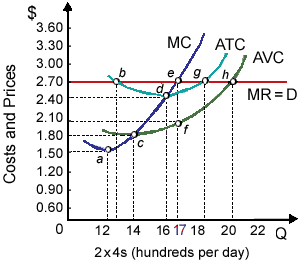
1947_Profit Maximization.png

Hello guys I want your advice. Please recommend some views for above Economics problems.

   Related Questions in Microeconomics

  • Q : Problem on Labor Unions and Wages The

    The Industrial unions try to accomplish wage rates above the competitive level through: (i) Limiting the supply of labor to the industry. (ii) Raising the supply of labor. (iii) Raising the productivity of the labor in an industry. (iv) Member’s agreeing to work

  • Q : Labor Union History Can someone please

    Can someone please help me in finding out the accurate answer from the following question. Preceding to the AFL-CIO merger in the year 1955: (i) AFL was an alliance of the industrial unions. (ii) The CIO was an alliance of the craft unions. (iii) Strikes over which un

  • Q : What is Imperfect data Imperfect data :

    Imperfect data: Most studies start with imperfect data. Few datasets involve the entire population of interest. Typically, the data has been gathered by others for specific purposes, and as such may have built in b

  • Q : Pure monopoly firm operates in purely

    In spite of of whether a firm is a pure monopoly or operates within a purely competitive industry as: (i) this should expect total revenue to cover total variable costs or this will not operate. (ii) the demand curve this faces will be horizontal in t

  • Q : Competition and Social Welfare The

    The purely competitive firm in an output market which hires from a purely competitive labor market will use labor at the point where VMP = W as the firm: (i) Operates in the society's best interest. (ii) Wants to be pretty fair to workers. (iii) Is eg

  • Q : Marginal social benefit and costs under

    Under pure competition, there is marginal social benefit will equivalent marginal social cost unless: (w) “hit and run” entrepreneurs prosper. (x) economic profits are zero. (y) there are externalities. (z) entrepreneurs a

  • Q : Annual payments of financial investment

    When the interest rate is 5 percent and a financial investment produces annual payments of $50,000, in that case the present value of this asset is as: (w) $1,000,000. (x) $5,000,000. (y) $500,000. (z) $10,000,000.

  • Q : Question on elasticity of demand Select

    Select the right ans wer of the question. The demand for agricultural products is: A) relatively elastic with respect to price. B) relatively inelastic with respect to price. C) relatively elastic with respect to income. D) downward sloping to the individual farmer, b

  • Q : Total costs of profit-maximizing lumber

    This profit-maximizing lumber mill incurs total costs of approximately: (a) $2200 per day. (b) $3300 per day. (c) $4200 per day. (d) $5200 per day (e) $6200 per day.

    Q : Minor Inefficiencies in Monopolistic

    Minor inefficiencies generated since monopolistic competitors differentiate their products may be more than offset through the: (w) increase in economic equity. (x) expansion of the psychologically-meaningful choices obtainable to consumers. (y) reduc