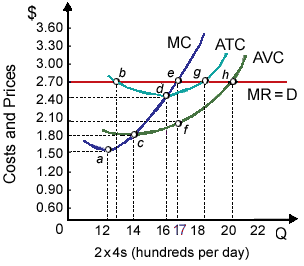
Total costs of profit-maximizing lumber mill
This profit-maximizing lumber mill incurs total costs of approximately: (a) $2200 per day. (b) $3300 per day. (c) $4200 per day. (d) $5200 per day (e) $6200 per day. How can I solve my Economics problem? Please suggest me the correct answer.
This profit-maximizing lumber mill incurs total costs of approximately: (a) $2200 per day. (b) $3300 per day. (c) $4200 per day. (d) $5200 per day (e) $6200 per day.
How can I solve my Economics problem? Please suggest me the correct answer.
In 2005 year, the proportion of people along with family incomes below the official poverty line into the United States was around: (w) one in eight. (x) one in ten. (y) two in twenty five. (z) one in twenty. Q : Monopoly Profits by Capitalization People who seek monopoly profits by buying the assets of successful monopolists will probably: (w) receive only normal returns onto the investment. (x) realize capitalized profits (y) attain monopoly economic profits. (z) thwart competition by innovating procedures of
People who seek monopoly profits by buying the assets of successful monopolists will probably: (w) receive only normal returns onto the investment. (x) realize capitalized profits (y) attain monopoly economic profits. (z) thwart competition by innovating procedures of
What is the marginal rate of transformation or marginal rate of substitution or marginal opportunity cost? Answer: It is the ratio of units of one good scarified to
Who decides price beneath perfect competition? Answer: Price under perfect competition is recognized by the forces of market demand and supply in business.
‘Describe the influence of London Olympics on economy?’
Reduction in the size of average American family is most probable to: (i) Erode rates of the technological advancement. (ii) Raise the demand for disposable diapers. (iii) Decrease women’s labor force participation rates. (iv) Increase the contribution of family
In short run, the demand for mink coats is least probable to change in response to: (i) Development of the petroleum based faux fur fabric which can’t be differentiated from genuine mink except via DNA analysis. (ii) Armies of a
Increasing the price of a product will raise total revenue proportionally into the unlikely event which demand was: (1) perfectly price elastic. (2) relatively price elastic. (3) unitarily price elastic. (4) relatively price inelastic (5) perfectly price inelastic.
Of the given price elasticities [ed] for market demand curves, there the one which is absolutely implausible by the vantage of standard economic theory would be one for that, across all conceivable ranges of prices: (1) ed= 0 and the
Market interest rates are LEAST affected through: (w) people’s willingness to defer consumption when they are rewarded for doing so. (x) people’s desires for liquidity. (y) the marginal productivity of new capital relative to its price. (z
18,76,764
1933846 Asked
3,689
Active Tutors
1446982
Questions Answered
Start Excelling in your courses, Ask an Expert and get answers for your homework and assignments!!