--%>

Supply curve for price elasticity of supply

Suppose that all these demonstrated curves are infinitely long straight lines. So, a supply curve for that price elasticity of supply is constant for each possible price and quantity is: (i) supply curve S2. (ii) supply curve S3. (iii) supply curve S5. (iv) none of the above.
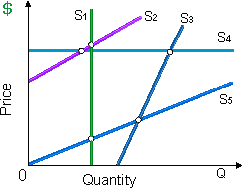
1234_Price Elasticity of Supply1.png

Can anybody suggest me the proper explanation for given problem regarding Economics generally?

   Related Questions in Microeconomics

  • Q : Least commonly finance investment in

    Business firms least commonly finance investment within new economic capital by: (w) retained earnings. (x) the issuance of common or preferred stocks. (y) borrowing from banks or other financial institutions. (z) gra

  • Q : Positive sloped labor supply curve Can

    Can someone help me in finding out the right answer from the given options. The monopsonist in labor market faces a: (1) Totally elastic demand for labor. (2) Completely elastic supply of the labor. (3) Completely inelastic supply of the labor. (4) Positively sloped l

  • Q : Marginal revenue for the pure monopolist

    Give the answer of following question. Price exceeds marginal revenue for the pure monopolist because the: A) law of diminishing returns is inapplicable. B) demand curve is downsloping. C) monopolist produces a smaller output than would a purely competitive firm. D) d

  • Q : Freedom to enter or leave the market in

    Purely competitive industries are not described by: (i) numerous potential buyers. (ii) product homogeneity. (iii) numerous potential sellers. (iv) freedom to enter or leave the market within the short run. (v) power to adjust quantities although no p

  • Q : Purpose of shortages of price in price

    Price ceilings tend to purpose of: (a) opportunity costs to decline. (b) monetary prices to rise legally. (c) shortages of price controlled goods. (d) black markets to disappear. (e) surpluses of goods at inflated prices.

    Q : Wages-Portion of costs Assume that a

    Assume that a firm with market power in output market wishes to grow up and that hiring more workers needs it to increase wages 8% for all the workers. Output prices will most likely: (1) Increase 8% to cover the wage raise. (2) Increase less than 8% as wages are only

  • Q : Product markets and labor markets

    Relative to firms which are price takers in both the product markets and labor markets, firms through market power in both the product markets and labor markets tend to. (1) Hire fewer workers and pay them less. (2) Rely more heavily on the screening and signaling thr

  • Q : Goal of profit sharing plans Give the

    Give the answer of following question. For the firm, the major goal of profit sharing plans is to: A) force workers to incur some of the business risk. B) overcome the monopsony problem of having to pay higher wages to attract additional workers. C) overcome the princ

  • Q : Change of tastes and preferences in

    Can someone please help me in finding out the accurate answer from the following question. Most of the mass advertising is intended to influence market demand primarily by: (1) Providing full detailed information regarding products. (2) Decreasing pro

  • Q : Price floors with government purchases

    Suppose the U.S. wheat market is primarily in a stable equilibrium upon S0D0. Assume now that the government institutes a legal price floor at P3 per bushel of wheat. When the government will buy and store any resulting surplus