--%>

Socially optimal output in perfectly price discriminate

Assume that no externalities in production or consumption exist and the income distribution is universally viewed such as “fair.” When this firm could price discriminate perfectly, one condition for socially optimal output would be for: (i) all potential consumer surplus to be converted to economic profit. (ii) roughly $8.50 to be charged for the 11,000th unit of output. (iii) marginal revenue to be zero for the last unit produced. (iv) all potential producer surplus to be converted to consumer surplus. (v) $12 to be charged for the 8,000th unit of output.
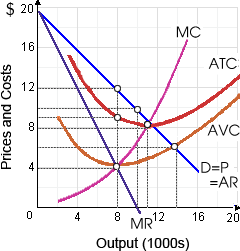
1918_Price Discrimination.png

Can anybody suggest me the proper explanation for given problem regarding Economics generally?

   Related Questions in Microeconomics

  • Q : Limitation of marginal revenue Marginal

    Marginal revenue is NOT: (i) similar as average revenue or price for a competitive firm. (ii) identical to the price of output for firms along with monopoly power. (iii) specified by (change in TR)/ (change into Q) for all firms. (iv) derived by the d

  • Q : Market in terms of economists To

    To economists, the noun ‘market’ signifies to: (1) The geographic place where many products are sold. (2) Any institution which enables sellers and buyers to strike bargains. (3) The New York Stock Exchange. (4) Selling goods and resources or stocks and bo

  • Q : Profit-maximizing competitor in short

    This profit-maximizing pure competitor would close down within the short run when the price fell below the price resultant to: (i) point c. (ii) point d. (iii) point e. (iv) point f. (v) point g.

    Q : Problem on annual implicit cost To

    To begin up his own business, Mitch quit his salaried job and invested $10,000 in savings which had earned him $1,000 per year in interest. He as well employs an apartment as his office that he previously had rented out for $6,500 per year. Which of the following is n

  • Q : Exploitation on resource suppliers Can

    Can someone help me in finding out the right answer from the given options. When resource suppliers are paid less than the values of their marginal products (or VMPs), they are stated to be: (i) Monopolistic. (ii) Exploited. (iii) Monopsonistic. (iv) In equilibrium.

  • Q : Loss in social welfare with quantity

    When pharmaceutical manufacturers conspire to generate only Q1 penicillin, in that case the: (i) purely-competitive firms which produced penicillin would experience economic losses. (ii) resulting excessive antibiotic treatments would produce strains of dru

  • Q : Social opportunity cost of resource

    Economic rent is: (w) income received by a factor owner in excess of the social opportunity cost of supplying the resource. (x) the difference between a firm’s revenues and the sum of the fixed and variable costs of production. (y) a form of eco

  • Q : Determine monthly maximum possible

    Maximum possible total revenue monthly from sales of RoboMaids is about: (i) $70 million. (ii) $100 million. (iii) $125 million. (iv) $170 million. (v) $230 million.

    Q : Shut down point of profit maximizing

    A profit maximizing competitive firm will shut down within the short run when: (w) prices do not cover average total costs. (x) this loses money on each unit of output. (y) price falls below the minimum of its AVC curve. (z) fixed costs exceed margina

  • Q : Twin problems of the U.S. health care

    Give the answer of following question. The twin problems of the U.S. health care industry are: A) rapidly rising costs and unequal access to health care. B) declining quality of health care and the duplication of specialized equipment at hospitals. C) declining per ca