--%>

Simulated demand

A department store faces a decision for a seasonal product for which demand can be high, medium or low. The purchaser can order 1, 2 or 3 lots of this product before the season begins but cannot reorder later. Profit projections (in thousands of euro) are shown below:
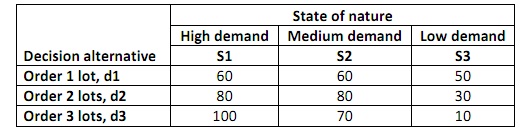
1220_simulated demand.jpg

1. If the probabilities are 0.3 for high, 0.3 for medium and 0.4 for low, what is the recommended order quantity? Calculate the expected return based on these values.

2.  Simulate twenty seasons and identify the recommended order quantity from this simulation ?

3. Calculate the average return based on the simulated demand and compare your result with the expected return ?

   Related Questions in Microeconomics

  • Q : Income effect of a wage Can someone

    Can someone help me in finding out the right answer from the given options. When the income effect of a wage raise is more powerful than the substitution effect, then the:  (1) Labor supply curve will be ‘backward bending’. (2) Unemployment rate will

  • Q : Oligopoly and Economic Welfare Assume

    Assume that P = MSB and the firms in an oligopoly are in equilibrium where P>MC. This follows that: (1) P=MSC. (2) MSB>MSC. (3) MSB<MSC. (4) oligopolists will gain zero economic profit. (5) the minimum point on the LRATC curve will achieved i

  • Q : Social purposes served by firms I have

    I have a problem in economics on Social purposes served by firms. Please help me in the following question. The broad social purposes served by the firms do not comprise: (1) Coordination of team production. (2) Maximization of the stockholder gains. (3) Reduction of

  • Q : Total variable costs of

    Total variable costs of this profit-maximizing lumber mill are approximately: (i) $2000 per day. (ii) $2400 per day. (iii) $2800 per day. (iv) $3200 per day. (v) $3600 per day.

    Q : Price discriminate by unregulated

    Unregulated monopolistic firms which do not price discriminate do NOT: (i) have power as price makers. (ii) dominate the supply side of the market. (iii) select profit maximizing price/quantity combinations from the market demand curv

  • Q : Central problems of an economy

    Elucidate the central problems of an economy: A) What to produce? B) How to produce? C) For whom to produce? Answer:

    Q : Marginal Resource Costs The word

    The word ‘marginal resource costs’ or ‘marginal factor costs’ signifies to the: (1) Additional cost included in generating an additional resource. (2) Additional cost included in generating an additional unit of the resource. (3) Additional cos

  • Q : Firm under monopoly A firm under

    A firm under monopoly a price maker by the reasons shown below:A) The monopolist is a single seller of the product in market. Therefore it has full control over supply.B) There are no close replacements of the monopoly product,

  • Q : Price crosses elasticity of demand when

    When a 2% raise in the price of Kibbles causes a 1% raise in the quantity sold of Bits, in that case their price cross elasticity of demand is approximately _____ and such goods are _____. (w) -2; complements (x) 0.5; substitutes (y) 2; substitutes (z

  • Q : Requirements for pure competition The

    The needs for pure competition are most intimately met by the market for: (i) domestic (American) steel. (ii) comic books. (iii) sugar-coated cereal within your local grocery store. (iv) stocks and bonds traded on Wall Street after they have been issu