--%>

Shifting supply of curve by entry of firms

When the price for Christmas trees is initially P1, in that case in the long run: (w) firms will neither enter nor exit this industry. (x) entry of firms will shift curve supply curve A to the right. (y) exit of firms will shift supply curve A to the left. (z) entry of new firms will shift that firm’s curve F to the right.
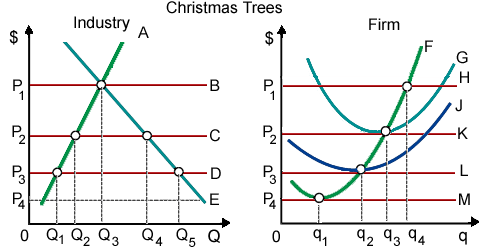
1091_supply and demand1.png

Can anybody suggest me the proper explanation for given problem regarding Economics generally?

   Related Questions in Microeconomics

  • Q : Kinked demand curve of an oligopoly

    The kinked demand curve of an oligopoly model supposes: (w) price increases will be followed. (x) price increases will be matched. (y) price declines will be matched. (z) any price changes will be matched.

    Q : Decreasing price of Complementary Goods

    The increase in demand for tartar sauce would be a probable result of: (1) A reduction in the price of fish. (2) An raise in the price of tartar sauce. (3) A bumper crop of the tartar sauce. (4) A raise in the price of fish. (v) The reduction in price

  • Q : Easily enter or exit the market in the

    This graph depicts a short run situation while long run equilibrium has been achieved for a firm along with some market (price-making) power when the firm cannot price discriminate and: (w) has explicit costs but no i

  • Q : Quantity supplied to relative change in

    The price elasticity of supply approximately measures the ratio of relative as: (w) profit to the amounts firms supply at different prices. (x) price increase necessary to induce a firm to raise output. (y) change within the quantity supplied to a rel

  • Q : Kinked demand curve for an oligopoly A

    A kinked demand curve for an oligopoly is probably when: (1) all the rival firms face identical demand curves. (2) rival firms are expected to match price cuts, but not price hikes. (3) firms ignore their rivals’ strategies when

  • Q : Trends in Income Distribution The year

    The year in that a long-run trend towards greater equality within the U.S. income distribution was reversed, therefore income since then has become less equally distributed, it was roughly: (w) 1945. (x) 1960. (y) 1975. (z) 1990.

    Q : Legal doctrine in Laws and Regulations

    Whenever goods are non-standardized and rarely purchased by an individual, an assumption that the sellers will contain superior knowledge of the product characteristics is an argument for applying the authorized doctrine of: (1) Caveat emptor. (2) Nolo contendere. (3)

  • Q : Problem on Agency Shop The union

    The union strategy which prevents the non-union employees of the firm from being free riders is to negotiate a contract which needs the firm to be a/an: (i) Agency shop. (ii) Open shop. (iii) Collective bargaining shop. (iv) Closed shop. (v) Union shop.

  • Q : Market Adjustments in outputs and

    Outputs and average prices for CDs and DVDs both rose throughout 1999 to 2000 (just before file sharing became ordinary), implying such that: (1) supply of prerecorded music should have grown. (2) law of demand does not apply to music. (3) demand for

  • Q : Problems regarding Attributes of Goods

    I have a problem in economics on Problems regarding Attributes of Goods. Please help me in the following question. The intrinsic characteristics which make or detract from the satisfaction derived from consuming a good are termed as: (1) Attributes. (2) Factors. (3) U