--%>

Selling price by price elasticity of unitary demand

At the point upon the demand curve for Silver Screen Classic DVDs, here the price elasticity of demand is unitary, the price would be approximately: (i) $10, resulting in roughly 8 million DVDs being sold. (ii) $13, resulting in approximately 6.5 million DVDs being sold. (iii) $16, resulting in about 5 million DVDs being sold. (iv) $20, resulting in around 3 million DVDs being sold. (v) $23.50, resulting in approximately 1million DVDs being sold.
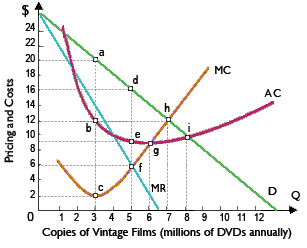
 

1624_maximize profit.png

How can I solve my Economics problem? Please suggest me the correct answer.

   Related Questions in Microeconomics

  • Q : Theory of production and cost

    The theory of production and cost supposes that the firms seek to maximize the: (i) Society's economic welfare. (ii) Their own gains. (iii) Sales revenues. (iv) Gross National Product. (v) National income. Find out

  • Q : Median Relative Income Measurement A

    A family which has income greater than half the median incomes of other American families, although less than twice which median income, is categorized by the Department of the Census as: (1) impoverished. (2) low relative income. (3) working class. (

  • Q : Prices and costs of investment goods

    The prices and costs of investment goods do not be likely to: (1) rise during periods of prosperity. (2) rise as demand for these goods increases. (3) fall throughout economic slumps. (4) fall as demand for these goods decreases. (5) fall as a result

  • Q : Financial Intermediation Financial

    Financial intermediation occurs while financial institutions: (w) incur substantial outflows of funds. (x) channel flows from the ultimate lenders to the ultimate borrowers. (y) face rigid reserve requirement ratios. (z) experience "runs" when deposit

  • Q : Economies of Scale problem Can someone

    Can someone please help me in finding out the accurate answer from the following question. When average production costs reduce as the total production of a firm rises, the firm is experiencing: (i) Economies of the scale. (ii) Economies of scope. (iii) Diseconomies o

  • Q : Price equality with marginal costs It

    It is not possible for a nondiscriminating, that profit maximizing monopolist to attain equilibrium where MR = MC as well as: (w) economic profit = 0. (x) economic profit is negative. (yz marginal costs are at the minimum of average costs [MC = ATC].

  • Q : Legal constraints in Labor Markets The

    The employer can legally pursue a policy of: (i) Wage discrimination which is based on the race or gender. (ii) Closed shop agreements with the unions. (iii) Firing the workers who join union. (iv) Wage discrimination mainly based on the employee’s seniority. (v

  • Q : Calculating economic profit for first

    Assume that the banker is employed at an annual salary of $60,000. She as well has financial assets worth of $40,000 which earns $1,500 per year in interest. She too owns a commercial building that she rents out for $20,000 per year. Now assume that she quits this job

  • Q : Problem on imperfect competition As MRP

    As MRP < VMP in imperfect competition if firms have market power as sellers: (1) MPPL = VMP. (2) The price of output surpasses MFC. (3) Monopolistic exploitation becomes essential to attain gain. (4) Imperfect competition can’t reach the equi

  • Q : Influences of Ceteris Paribus The Latin

    The Latin phrase applies to the idea which all other effects on some dependent variable are to be supposed constant if examining the effect of changing a single independent variable is as: (1) Fiat justitia, ruat coelum. (2) Platea unum. (3) Unum paribus. (4) Ceteris