--%>

Relatively inelasticity in supply curve

At point c, in illustrated figure the supply curve into this graph is: (w) perfectly price elastic. (x) relatively price elastic. (y) unitarily price elastic. (z) relatively inelastic.
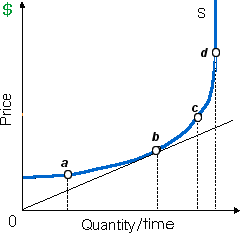
1300_Price Elasticity of Supply3.png

I need a good answer on the topic of Economics problems. Please give me your suggestion for the same by using above options.

   Related Questions in Microeconomics

  • Q : Question 2 Explain the concept of a

    Explain the concept of a concentration ration. Is the concentration ratio in a monopolistically competitive industry likely to be higher than for a perfectly competitve industry? Explain the answer

  • Q : Transfer payment by excesses income A

    A person’s wage income into excess of which that would be received by accepting the next best optional use of his or her talents is: (1) an economic rent. (2) a transfer payment. (3) an interest premium. (4) a salary bonus. (5) nominal wages.

  • Q : Expectations in market demands for

    Present market demands for most of the durable goods tend to rise if: (1) Their prices are predicted to rise in the near future. (2) Consumers expect growth in supplies of substitutes. (3) Technological advances make present models obsolete. (4) The p

  • Q : Substitution effects resulting from

    The Law of Demand mainly relies heavily on the: (1) Buying power consequences of relative price modifications. (2) Substitution effect resultant from the relative price changes. (3) Increase in opportunity costs as income is worn out. (4) Principle of the non satiety.

  • Q : Fixed costs of a purely competitive firm

    The fixed costs of a purely competitive firm are: (w) incurred within the short run even if no output is produced. (x) wage payments and raw materials costs. (y) the bulk of short run opportunity costs. (z) not found by earlier decisions.

  • Q : Attribute Demand Curve for Bonds A

    A demand curve for bonds moving to the right is probably to be attributable to: (w) a business cycle recession. (x) lower expected (future) interest rates. (y) an increase into the expected rate of inflation. (z) an increase in the liquidity of altern

  • Q : Cut price and earn negative profit A

    A huge firm may cut price and earn negative profit when a new firm enters the market so as to: (w) induce the new firm to exit. (x) build a reputation for cutting price so as to deter future entry. (y) gain market control. (z) All of the above. <

  • Q : Laws and Regulations-caveat emptor I

    I have a problem in economics on Laws and Regulations-caveat emptor. Please help me in the following question. The Latin phrase which means ‘let the buyer beware is: (1) Caveat emptor. (2) Laissez-faire. (3) Fiat justitia and ruat coelum. (4) Epluribus unum. (5)

  • Q : Marginal cost Give the answer of

    Give the answer of following question. Refer to the given data. The marginal cost of producing the sixth unit of output is: A) $24. B) $12. C) $16. D) $8. 432_f</span></p>
                                        </div>
                                        <!-- /comment-box -->
                                    </li>
   
   </td>
	</tr><tr>
		<td>
       
      <li>
                                        <div class=

    Q : Income and Substitution effects problem

    Economists decompose how the consumers react to a change in price of a good into the: (1) Diminishing marginal utility effect and indifference effect. (2) Indifference effect and enhancement effect. (3) Net utility effect and preference effect. (4) Income effect and s