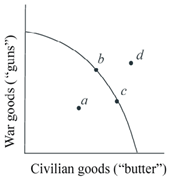
Question based on production possibilities curve
In drawing the production possibilities curve we assume that: 1) technology is fixed. 2) unemployment exists. 3) economic resources are unlimited. 4) wants are limited. Help me in getting answer of this que.
In drawing the production possibilities curve we assume that: 1) technology is fixed. 2) unemployment exists. 3) economic resources are unlimited. 4) wants are limited.
Help me in getting answer of this que.
The purely competitive model: (w) is characteristic of many actual U.S. market structures. (x) analyzes a type of economy which is now extinct. (y) is a helpful abstraction from actuality for analyzing firms’ behavior. (z) proves which modern ca
This purely-competitive lumber mill experiences on the average day is an: (w) economic profit of about $340. (x) economic loss of roughly $150. (y) accounting profit of less than $300. (z) accounting loss of more than $100. Q : Ratio of Wealth and Poverty In 1980 In 1980 year, the chief executive officers that stand for CEOs of main corporations had income which averaged roughly 40 times as much as the workers they working. In 2005, such ratio is less than: (1) twenty to one. (2) forty to one. (3) one hundred
In 1980 year, the chief executive officers that stand for CEOs of main corporations had income which averaged roughly 40 times as much as the workers they working. In 2005, such ratio is less than: (1) twenty to one. (2) forty to one. (3) one hundred
Price discrimination: The Price discrimination is a situation whenever a monopolist charges distinct price from various buyers of the similar product. This is usually done to maximize profits.
Elucidate the role of margin requirements for correcting deflationary gap.
Economic profits are NOT recompenses to entrepreneurs who: (1) endure business uncertainty. (2) provide society along with economic capital. (3) innovate new goods and technologies. (4) exercise monopoly power or monopsony power. (5)
Household’s demand for a poorer good tends to fall if: (1) Supplies of complementary goods increase. (2) Prices of alternate goods increase. (3) Family income rises. (4) Its own price drops/falls. Can someone
Compared along with pure competition or monopoly, not perfect competition is: (w) far more common in Europe than in the United States. (x) much more common in markets during the world. (y) much less common in advanced nations than in underdeveloped na
Supposing that the competitive firms should seek the maximum profits to survive signifies that: (1) Firm do not make trial-and-error decisions. (2) Each and every firm always seeks the maximum gain and nothing else. (3) Competition is very profitable.
Even although less than 12 percent of labor in the U.S. is unionized, numerous argue that unions are the primary cause of inflation as union wage hikes: (i) Cause unemployment that is inflationary. (ii) Frequently serve as the goals in recognizing non-union wage. (iii
18,76,764
1950462 Asked
3,689
Active Tutors
1444824
Questions Answered
Start Excelling in your courses, Ask an Expert and get answers for your homework and assignments!!