--%>

Profit maximizing strategy at breakeven point

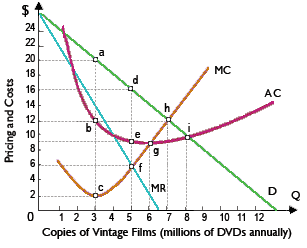
Nostalgia Corporation would exactly break-even on its Silver Screen DVDs when, in place of correctly identifying its profit maximizing strategy, this: (w) operated at point i, charging only $10 per DVD and producing 8 million DVD. (x) priced each DVD at $24 and sold only 900,000 copies. (y) charged $16 per DVD and sold 5 million DVDs. (z) produced 6.5 million DVDs and sold them for $13.50 apiece.
758_maximize profit.png

Hello guys I want your advice. Please recommend some views for above Economics problems.

   Related Questions in Microeconomics

  • Q : MOST Negative Liquidity An asset's

    An asset's liquidity is, by description, MOST negatively associated to the: (1) asset's suitability as a commodity money. (2) transaction costs incurred in its purchase or sale. (3) speed with which that can be sold. (4) certainty about its market pri

  • Q : Laws and Regulations-Seller of the good

    The Caveat venditor is an ancient legal doctrine which, when the products are defective or fraudulently symbolized, imposes legal liabilities on: (1) Seller of the good. (2) Government, for failing to save consumers. (3) Resource owner. (4) Buyer, for failing to use d

  • Q : Labor Contracts-Featherbedding The

    The Restrictive work rules which need firms to employ more workers than essential are termed as: (i) Feather-bedding. (ii) Seniority contracts. (iii) Blacklisting regulations. (iv) Agency shop provisions. (v) Yellow dog contracts.

  • Q : Monopolistic Exploitation dilemma In

    In equilibrium for the price maker firm, the rate of monopolistic exploitation is the difference between: (p) P and MR. (q) P and MC. (iii) Total revenue and net cost per unit of output. (r) Output price and rate of monopsonistic exploitation. (s) VMP and MRP.

  • Q : Opinion about kinked demand curve model

    George Stigler concluded which the kinked demand curve model is incorrect to the extent that this depends on: (w) marginal cost pricing. (x) pure competition. (y) interdependent decision making.  (z) sticky prices.

  • Q : Determine price elasticity of perfectly

    A city government trying to pass an excise tax for that the economic burden would be borne strictly through the seller will succeed when this imposes a tax on a good for that the price elasticity of: (i) demand is unitarily elastic. (

  • Q : Buying something when expect a price to

    Buying since you expect a price to increase, at that point you will sell, which is termed as: (w) arbitration. (x) speculation. (y) profiteering. (z) arbitrage. Hey friends please give your opinion for the problem

  • Q : Funding crisis The Social Security

    The Social Security program in the United States faces a long-term funding crisis because: 1) the Social Security trust fund was exhausted in the year of 2002. 2) the number of retirees receiving benefits is rising more rapidly than the number of workers paying payrol

  • Q : Demands for productive resources The

    The demands for productive resources are eventually “derived” by the: (w) marginal utility they directly generate. (x) demands for consumer goods and services. (y) disutility incurred in supplying labor. (z) equity of resource owners as ju

  • Q : Opponents of the current welfare system

    Opponents of the current welfare system who desire the welfare system scaled down tend to argue which this: (1) has constantly experienced funding cuts for the past decade. (2) cannot succeed in helping poor people within a market economy. (3) stimula