--%>

Problem regarding to trade barriers for export subsidies

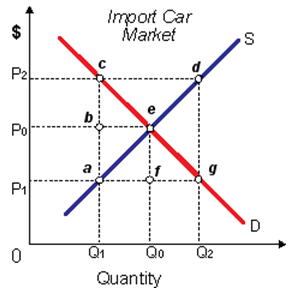
When the import market was within equilibrium before the Japanese government began subsidizing all autos exported by the amount dg, in that case U.S. car buyers would be: (w) pay P2 for a car previouslszy priced at P0. (x) suffer Q0 toQ1 unemployment, and will buy fewer imports. (y) gain profit equal to the irregular area bcdge. (z) wind up paying P1 each for Q2 imported cars.
188_Trade Barriers.png

I need a good answer on the topic of Economic problems. Please give me your suggestion for the same by using above options.

   Related Questions in Microeconomics

  • Q : When market for a good is in equilibrium

    Whenever the market for the good is in equilibrium, this signifies that the: (i) Demand and supply are equivalent. (ii) Tax wedge is perfectly offset by the government advantages. (iii) Differences among demand prices and supply prices equivalent profit per unit. (iv)

  • Q : Describing the problem of Moral Hazard

    When an NBA all-star bets in opposition to his team in games he plays after getting the money designated in his contract, he would be describing the problem of: (1) Default a version. (2) Over achievement. (3) Moral hazard. (4) Stupidity.

    Q : Oligopoly market Elucidate why are

    Elucidate why are firms mutually interdependent in oligopoly market.

  • Q : Exploitation problem If the resource

    If the resource suppliers are paid less than the values of their marginal products [VMPs], then they are stated to be: (i) In equilibrium. (ii) Exploited. (iii) Monopolistic. (iv) Monopsonistic. Can someone please help me in findin

  • Q : Minimizes average cost of output When a

    When a monopolist maximizes profit and charges a price equivalent to average cost, in that case the firm: (i) is producing at the minimum point on its marginal cost curve. (ii) also charges a price equal to marginal cost. (iii) is pro

  • Q : Kinked demand curve for an oligopoly A

    A kinked demand curve for an oligopoly is probably when: (1) all the rival firms face identical demand curves. (2) rival firms are expected to match price cuts, but not price hikes. (3) firms ignore their rivals’ strategies when

  • Q : Perfectly price inelastic demand For

    For Cournot’s Spring Water the demand is perfectly price inelastic at: (i) point a. (ii) point b. (iii) point c (iv) point d. (v) point e.

    Q : Powerful negative externalities in

    Potentially powerful negative externalities are mainly overwhelmingly a decisive argument against permitting laissez faire policies and supplies to govern the production and market demands and distribution of: (1) avian flu antivirus shots. (2) public

  • Q : Transactions increment and moves in

    Transactions increase and demand prices move below supply prices while a good turns into: (w) subsidized by the government. (x) subject to a high sales tax. (y) more technologically advanced. (z) a complementary by pr

  • Q : Theory of microeconomic game in market

    The theory of market structure which several microeconomic game theorists were ready to toss within the dustbin of intellectual history into the 1970 year but that, in the early 1980s, turned into a foundation for the “new&rdquo