--%>

Problem regarding to First Mover Advantage

Carlos and Ivana both are roommates and friends. Carlos and Ivana eat together regardless of who cooks. When this game is repeated almost daily, and on Thursday, Ivana is permitted to pick first, the probable result is that: (w) neither Carlos nor Ivana cook, nor do they eat. (x) Carlos alone cooks for both of them. (y) Ivana alone cooks for both of them. (z) Carlos and Ivana share the cooking chores, and after that they eat together.
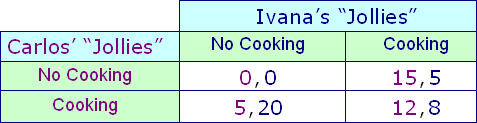
1023_Problem on Nash Equilibrium.png

How can I solve my Economics problem? Please suggest me the correct answer.

   Related Questions in Microeconomics

  • Q : Annual Percentage Rate and Annual

    Interest stated at an annual percentage rate that stands for APR is the rate of interest without consideration of compounding throughout that year. Yearly or annual percentage yield [APY] refers to interest which is compounded continuously. When a ban

  • Q : Categorizing goods into intermediate

    Describe the basis of categorizing goods into intermediate and final goods. Give appropriate illustrations.

  • Q : Profit Maximization-total revenue-total

    The entire profit maximizing organization will hire more labor up to the point where: (i) Average physical product of labor equivalents the nominal wage. (ii) Last unit of labor adds uniformly to net revenue and net cost. (iii) Marginal product of the labor is at its

  • Q : Problem related to Sellers markets

    Seller’s markets frequently exist when: (i) There are extensive surpluses. (ii) Prices are increasing. (iii) The government enforces price floors. (iv) Inventories are much high. Can someone please help me in finding out the

  • Q : State the relationship between MPC and

    State the relationship between MPC and multiplier? Answer: The value of multiplier differs directly with MPC.  K=1/1 - MPC.

  • Q : Which of the following lists includes

    Which of the following lists includes only capital resources (and therefore no labor or land resources)?

  • Q : Total costs of profit-maximizing lumber

    This profit-maximizing lumber mill incurs total costs of approximately: (a) $2200 per day. (b) $3300 per day. (c) $4200 per day. (d) $5200 per day (e) $6200 per day.

    Q : When is demand more elastic at a price

    Along this demonstrated in below demand curve for DVD games, demand is more elastic at a price of: (w) $10. (x) $6. (y) $1. (z) zero.

    Q : Output of profit-maximizing monopolist

    Hybrid Roses is the merely florist in 60 miles of Presidio, Texas. When total fixed costs (for example, rent and utilities) are $9 per hour, such profit-maximizing monopolist will generate an output of: (1) two dozen roses per hour. (

  • Q : Cartel Select the right answer of the

    Select the right answer of the question. We would expect a cartel to achieve: A) both allocative efficiency and productive efficiency. B) allocative efficiency, but not productive efficiency. C) productive efficiency, but not allocative efficiency. D) neither allocati