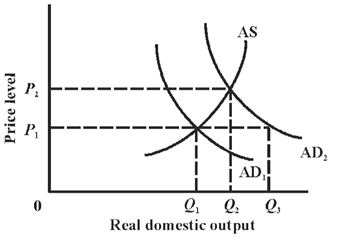
Problem on price level-real domestic output
Refer to the below diagram. Give me answer of this question. If equilibrium real output is Q2, then: A) aggregate demand is AD1. B) the equilibrium price level is P1. C) producers will supply output level Q1. D) the equilibrium price level is P2.
Opponents of contribution standard for income distribution, the: (w) prefer a more efficient mechanism to distribute income. (x) accept marginal productivity theory. (y) question how well the market system measures productivity. (z) generally favor de
The price elasticity of supply is zero therefore supply is perfectly price inelastic within: (w) Panel A. (x) Panel B. (y) Panel C. (z) Panel D. Q : Total fixed cost in competitive firm This competitive firm's fixed cost or TFC in demonstrated can be computed as area as: (i) 0P3fq4. (ii) P2P1de. (iii) P3P2ef. (iv) 0P2eq4. (v) aced. Q : Marginal Utilities and Demand Prices Can someone help me in finding out the right answer from the given options. Rational individual consumers tend to purchase goods until the relative market prices for each and every goods purchased are proportional to all individuals: (i) Cost or benefit ratio. (ii) Op
This competitive firm's fixed cost or TFC in demonstrated can be computed as area as: (i) 0P3fq4. (ii) P2P1de. (iii) P3P2ef. (iv) 0P2eq4. (v) aced. Q : Marginal Utilities and Demand Prices Can someone help me in finding out the right answer from the given options. Rational individual consumers tend to purchase goods until the relative market prices for each and every goods purchased are proportional to all individuals: (i) Cost or benefit ratio. (ii) Op
Can someone help me in finding out the right answer from the given options. Rational individual consumers tend to purchase goods until the relative market prices for each and every goods purchased are proportional to all individuals: (i) Cost or benefit ratio. (ii) Op
Associate to short-run supply curves, in long-run industry supply curves tend to be additionally: (i) vertical. (ii) positively-sloped. (iii) profitable. (iv) income inelastic. (v) price elastic. C
Question #2 Consumer Demand. How to answer questions from a-g iii. I belive the MRS is 2y/x for B. But not sure
Can someone help me in finding out the right answer from the given options. Illustrations of complementary goods would not comprise: (1) Football tickets and rugby tickets. (2) Golf clubs and golf balls. (3) Laundry detergent and washing machines. (4)
The Screening devices employed whenever employers try to save adverse selection by the applicants for place do not comprise: (i) review resumes to recognize applicant’s qualifications. (ii) Needing non-compete clauses which prevent latest employees from working
A successful strategy of product differentiation causes: (w) the demand curve to shrink and become more elastic. (x) the demand curve becomes perfectly elastic. (y) prices for close substitutes to equalize. (z) the marginal revenue curve to be below t
The profit-maximizing price for RoboMaids is: (1) $24,000 per robot. (2) $20,000 per robot. (3) $16,000 per robot. (4) $12,000 per robot. (5) $10,000 per robot. Discover Q & A Leading Solution Library Avail More Than 1439129 Solved problems, classrooms assignments, textbook's solutions, for quick Downloads No hassle, Instant Access Start Discovering 18,76,764 1955823 Asked 3,689 Active Tutors 1439129 Questions Answered Start Excelling in your courses, Ask an Expert and get answers for your homework and assignments!! Submit Assignment
18,76,764
1955823 Asked
3,689
Active Tutors
1439129
Questions Answered
Start Excelling in your courses, Ask an Expert and get answers for your homework and assignments!!