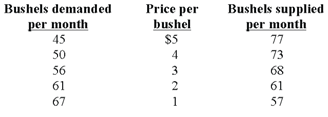
Problem on equilibrium price
Refer to the following data. Equilibrium price will be: A) $4. B) $3. C) $2. D) $1. Give the answer of above questaion
Refer to the following data. Equilibrium price will be: A) $4. B) $3. C) $2. D) $1.
Give the answer of above questaion
In economics, what is ordinal utility and what are its assumptions
Select the right answer of the question. Monopolistic competition means: 1) a market situation where competition is based entirely on product differentiation and advertising. 2) a large number of firms producing a standardized or homogeneous product. 3) many firms pro
Which of the given is the best statement of the association between macroeconomics and microeconomics: (w) Macroeconomics and microeconomics deal along with totally independent types of problems. (x) A clear line splits microeconomic questions from ma
Pure economic profits are NOT: (w) normal costs of production. (x) reduced to “normal” levels in long-run pure competition. (y) zero in long run monopolistic competition. (z) possible under pure competition in the short-run.
Optimal Sample Size: The optimal or suitable size of sample in a survey or poll is the function of four discrete factors: 1. Size of the population: The size of the
The sum up of monopsonistic exploitation by the firm raises however the firm as well operates at a more socially and economically proficient level of output and employment whenever the firm is capable to engage in: (i) Blacklisting in its hiring of the labor. (ii) Yel
When wage discrimination is not possible for first 40 workers then this profit-maximizing firm hires, however it can wage discriminate perfectly whenever hiring all the subsequent workers, it hires a net of: (i) Forty workers at an average wage of the
Economic good becomes an economic bad whenever consumption is expanded into an area where: (1) Marginal returns are reducing. (2) Sellers experience an honest hazard. (3) Marginal utility is negative. (4) Buyers suffer from unfavorable choice. (5) Exc
The ratio of the percentage change within the quantity of beef sold over the percentage change within the price of pork is: (1) price elasticity of demand for beef. (2) price elasticity of demand for pork. (3) income elasticity of dem
Whenever economic profit equivalents zero, then the accounting profits: (i) Are explicit costs of the remaining in business. (ii) Will induce raised investment even when accounting costs are much low. (iii) Are too zero. (iv) Reflect normal returns on the investment t
18,76,764
1930731 Asked
3,689
Active Tutors
1449740
Questions Answered
Start Excelling in your courses, Ask an Expert and get answers for your homework and assignments!!