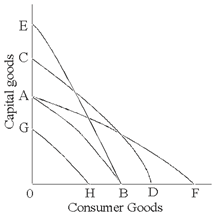
Problem based on shift of the production possibilities curve
Technological advance in producing both capital goods and consumer goods is illustrated by the shift of the production possibilities curve from AB to: 1) CD. 2) EB. 3) AF. 4) GH. Select the right answer for above given question
Technological advance in producing both capital goods and consumer goods is illustrated by the shift of the production possibilities curve from AB to: 1) CD. 2) EB. 3) AF. 4) GH.
Select the right answer for above given question
According to several critics who favor reducing welfare payments, and existing welfare programs as: (1) cannot cure poverty without substantial funding hikes. (2) are justified only when they increase total production. (3) harm poor people by creating
Can someone help me to solve this problem as given below: A profit maximizing firm will generate where: (w) MR > MC. (x) MC > MR. (y) MR = MC. (z) ATC > P > MC. How can I solve my
When directory assistance adds to the variable costs of cell phone Company, in that case the efficient price for directory assistance from the vantage point of society as an entire would be: (w) zero. (x) one that covered the average
The Characteristics common to most of the successful entrepreneurs do not comprise: (1) Vision and timing. (2) Conviction and action. (iii) Luck and the bureaucratic one-upmanship. (iv) Determination and workaholics. Can someone pl
The law of demand defines that there is a negative relationship among: (1) A good’s price and quantity demanded. (2) Limitless demands and inadequate resources. (3) The quantities demanded and supplied. (4) People’s income and demands for
When the Kroger grocery chain raises the price of Starbuck’s Frappuccino, in that case Safeway will remain its price the same. Although, if Kroger drops the price of Frappuccino, then Safeway will match the price cut. This kind of behavior conforms to the: (1) s
Price elasticities of demand tend to as: (i) fall as higher prices are charged. (ii) rise as higher prices are charged. (iii) almost always be constant. (iv) not be associated to the length of time. (v) not be influenced by price changes.
The transfer of wealth from industrialized countries to oil exporting countries (OPEC) which followed skyrocketing oil prices within the 1970 year indicates such that the price elasticity of demand for oil: (w) relatively low. (x) relatively high. (y)
Whenever an organization’s wage structure reflects the keenness of individual staff to work, terms which are most applicable comprise: (i) Monopsonistic exploitation & wage discrimination. (ii) Monopolistic exploitation and the separation of possession and c
settlement range between management and the trade union
18,76,764
1930100 Asked
3,689
Active Tutors
1419695
Questions Answered
Start Excelling in your courses, Ask an Expert and get answers for your homework and assignments!!