--%>

Price increment for higher total revenue

A price increase for Pixie’s cheesy fried grits by P1 to P2 would yield higher total as: (w) revenue because demand is price elastic. (x) supply since demand is unitarily elastic. (y) revenue since demand is price inelastic. (z) use of the good relative to its substitutes.
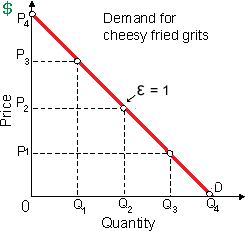
808_Price Elasticity of Demand5.png

Can anybody suggest me the proper explanation for given problem regarding Economics generally?

   Related Questions in Microeconomics

  • Q : Structure-conduct-performance From

    From roughly 1890 till 1970 year, the “structure-conduct-performance paradigm” controlled theories regarding how firms behave in various types of markets. The term “structure” in this expression refers to such

  • Q : Characteristic of a purely competitive

    A purely competitive firm: (w) faces a perfectly inelastic demand curve. (x) sets its own price. (y) is a price taker. (z) sells a differentiated product. Can someone explain/help me with best solution about proble

  • Q : Managerial Economics-Error of omission

    Can someone please help me in finding out the precise answer from the following question. The ‘error of omission’ takes place when: (1) Managers pursue policies which outcome in layoffs. (2) Corporations vend more stock than is really available. (3) Manage

  • Q : Classified industries as oligopolistic

    Industries which would be classified as oligopolistic comprise: (w) public utilities. (x) postal service. (y) breakfast cereal. (z) retailing. Hello guys I want your advice. Please recommend some views for above

  • Q : Exploitation of Labor I have a problem

    I have a problem in economics on Exploitation of Labor Please help me in the following question. The exploitation might not exist even when wage a worker is paid is less than the worker’s: (1) average revenue product. (2) The value of marginal p

  • Q : Amount of output supplied and price

    The amount of output supplied is exactly proportional to the price therefore the price elasticity of supply equivalents one into: (w) Panel A. (x) Panel B. (y) Panel C. (z) Panel D.

    Q : Analytic Time-The Market Immediate The

    The analytical period of time is very short that the firm could not adjust output by hiring more or less of a variable resource was recognized by Alfred Marshall as: (1) Immediate or market period. (2) Long run. (3) Short run. (4) Technological or temporal long run.

  • Q : Stickiness of prices in oligopolistic

    The "kinked-demand-curve" model was developed into the 1930 year in part to help describe: (i) barriers to entry in oligopoly markets. (ii) the allegedly excessive stickiness of prices into oligopolistic industries. (iii) how competitive industries be

  • Q : Resource market in equilibrium demand

    When the resource market shown in this illustrated figure is initially within equilibrium along with demand curve D0: (w) owners of these resources currently receive no economic rents. (x) economic rent is specified by area

  • Q : Problem related to Sellers markets

    Seller’s markets frequently exist when: (i) There are extensive surpluses. (ii) Prices are increasing. (iii) The government enforces price floors. (iv) Inventories are much high. Can someone please help me in finding out the