--%>

Nonlinear kinked demand curve

Within this "kinked-demand curve" model, that firm views the demand curve this faces as the: (w) linear "kinked" demand curve aD2 for all prices. (x) linear "kinked" demand curve D1D1 for all prices. (y) nonlinear "kinked" demand curve D1cD2. (z) nonlinear "kinked" demand curve acD1.
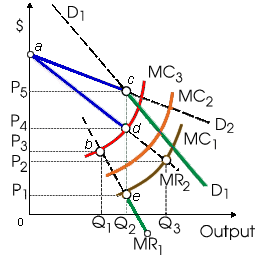
1930_Kinked Demand Curve.png

I need a good answer on the topic of Economics problems. Please give me your suggestion for the same by using above options.

   Related Questions in Microeconomics

  • Q : Problem relating to current demands for

    The people who anticipate prices to increase soon will tend to rise their: (i) Current demands for the durable goods. (ii) Waiting time prior to buying. (iii) Saving as a result they can afford higher prices. (iv) Current supplies.

  • Q : Examples of Complementary Goods Can

    Can someone help me in finding out the right answer from the given options. Illustrations of complementary goods would not comprise: (1) Football tickets and rugby tickets. (2) Golf clubs and golf balls. (3) Laundry detergent and washing machines. (4)

  • Q : Economic concept of total costs I have

    I have a problem in economics on Economic concept of total costs. Please help me in the following question. The economic concept of total costs and the bookkeeper’s concept of net costs differ as economists: (1) Place a lower value on the psychi

  • Q : Please In the quintile distribution of

    In the quintile distribution of income, the term "quintile" represents: A 5 percent of the income receivers. B 10 percent of the income receivers. C 15 percent of the income receivers. D 20 percent of the income receivers.

  • Q : Problem on adjustments in Income Effect

    Whenever your purchasing power drops as the price of a good you purchase increases, you make adjustments as of the: (1) Marginal utility effect. (2) Price level effect. (3) Income effect. (4) Consumer excess effect. Choose the righ

  • Q : Produce a natural monopoly by market

    Market forces tend to produce a natural monopoly while: (1) decreasing costs are small relative to market demand for output. (2) diseconomies of scale are substantial at low levels of output. (3) economies of scale are substantial relative to market d

  • Q : Profits and Losses in firms Of all the

    Of all the profits made by the U.S. firms, corporations account for regarding: (1) Less than 10 percent. (2) Between 10 percent and 20 percent. (3) Between 20 percent and 40 percent. (4) More than 40 percent. Can someone please hel

  • Q : Least possible cost for primary economy

    The least possible costs of alternative outcomes to the primary economic question of “what?” can be represented with the production possibilities curve through: (1) The slopes of movements all along the curve. (2) Shifting the curve up by

  • Q : Characteristics of purely competitive

    Characteristics of purely competitive markets do not comprise: (w) homogeneous products. (x) large numbers of potential buyers. (y) large numbers of potential sellers. (z) the capability of sellers to set prices. I

  • Q : Purchasing ratio maximizing the total

    The consumer who spends income and hence the ratio of MUs of all goods purchased equivalents the ratio of their prices is: (i) Maximizing net utility. (ii) Spending too much. (iii) Beyond the point of diminishing negative utility. (iv) Behaving incompatibly through pu