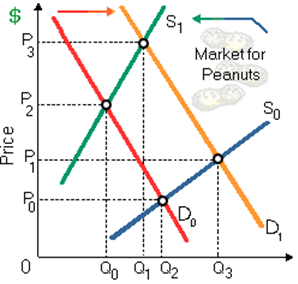
Market initially at price and quantity
This market for peanuts is primarily into equilibrium at price: (w) P0 and quantity Q0 (x) P1 and quantity Q0 (y) P2 and quantity Q2 (z) P1 and quantity Q1 How can I solve my economics problem? Please suggest me the correct answer.
This market for peanuts is primarily into equilibrium at price: (w) P0 and quantity Q0 (x) P1 and quantity Q0 (y) P2 and quantity Q2 (z) P1 and quantity Q1
How can I solve my economics problem? Please suggest me the correct answer.
When a firm hires workers to a point where VMP > MRP = MFC = W then: (1) There is a bilateral monopoly condition. (2) Wage discrimination is being exercised. (3) There is monopolistic exploitation of the workers. (4) The firm consists of monopsony power.
When a supply curve is a straight line start from the origin, in that case supply is: (i) relatively elastic for all prices and quantities. (ii) relatively inelastic for all prices and quantities. (iii) unitarily elastic for all prices and quantities.
Even though a drought decreases supply from S1 to S0, at each point along both of such supply curves, the supply of tanks of dehydrated water: (i) perfectly price elastic. (ii) relatively price elastic. (iii) unitarily price elastic. (iv) relativ
The entire profit maximizing organization will hire more labor up to the point where: (w) Average physical product of labor equivalents the nominal wage. (x) Last unit of labor adds uniformly to net revenue and net cost. (y) Marginal product of the labor is at its hig
Normal 0 false false
The tobacco industry within the United States is a good illustration of: (1) monopoly. (2) pure competition. (3) oligopoly. (4) corporate responsibility. (5) duopoly. I need a good answer on the topic of Economics
When the capital-to-labor (K/L) ratio raises: (1) capital becomes more productive. (2) the interest payments to capital will raise. (3) the wages to labor will probably reduce. (4) labor productivity should rise. (5) the price of capital increases.
The purely competitive industry’s demand for the labor is: (i) Less elastic than the horizontal summation of individual firm’s demands. (ii) Perfectly elastic. (iii) Upward sloping as of the diminishing marginal returns to labor. (iv) Equi
I have a problem in economics on Substitution problem on consumption. Please help me in the following question. Teddy forever eats peanut butter and jelly sandwiches for lunch as he should live on $20 dollars a week. Jelly jumped in price and, to plea
Each and every profit-maximizing firm which can cover its variable costs will hire the labor: (1) Just to the point of the diminishing returns. (2) Just to the point where MRP = ARP for the final worker hired. (3) Beyond the point of the diminishing r
18,76,764
1961445 Asked
3,689
Active Tutors
1427237
Questions Answered
Start Excelling in your courses, Ask an Expert and get answers for your homework and assignments!!