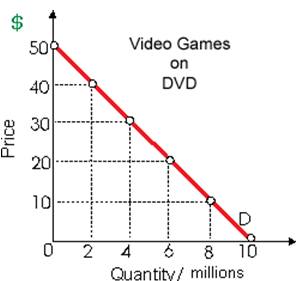
Lowering prices raises total revenue for demand elasticity
Lowering prices will raise total revenue from DVD game sales at all prices as: (w) on this demand curve. (x) below $25. (y) above $25. (z) below $30. How can I solve my economics problem? Please suggest me the correct answer.
Lowering prices will raise total revenue from DVD game sales at all prices as: (w) on this demand curve. (x) below $25. (y) above $25. (z) below $30.
How can I solve my economics problem? Please suggest me the correct answer.
When, after hiring the very last worker, the organization’s profit is similar as it was before the last worker was hired, then the firm must: (p) Hire more workers to raise the profit. (q) Layoff some workers to raise the profit. (r) Not appoint any more workers
James and Louisa each have an income of $30, which they each spend on tomatoes and all other goods. They buy tomatoes at their local farmers market, which charges $3 per pound. Define the units for all other goods so that their price is $1 per unit.
When your income is positively and closely tied to the price of a specific product, a raise in its price might cause: (1) The income effect which, in severe conditions, yields a positively sloped demand curve. (2) You to go bankrupt. (3) The powerful positive substitu
Utilitarianism states that the best society is one which gives the: (1) Essential goods to meet people’s requirements. (2) Biggest happiness for the greatest number of people. (3) Precise measurement of disutility and utility. (4) Highest guaran
Can someone please help me in finding out the accurate answer from the following question. Which of the given below is not an illustration of horizontal integration? (1) Prudential Insurance gets Metropolitan Life Insurance. (2) Daimler-Benz absorbs Chrysler. (3) McDo
Describe the consumer’s equilibrium in case of two commodities (IC) approach. Answer: Consumer equilibrium refers to a condition when he spends his specified
I have a problem in economics on Existence of Economies of Scale. Please help me in the following question. Economies of the scale exist whenever, as output is raised: (i) Average costs increase. (ii) Explicit costs increase relative to the value of output. (iii) Aver
According to several critics who favor reducing welfare payments, and existing welfare programs as: (1) cannot cure poverty without substantial funding hikes. (2) are justified only when they increase total production. (3) harm poor people by creating
When a $9.98 sale on regular $19.95 watch fobs increases a store's sales from 30 to 300 weekly, the price elasticity of the demand faced through the store is approximately: (w) 2.46. (x) 1.23. (y) 4.92. (z) 0.62. C
One of the major disadvantages of the corporation is: (i) Double taxation of its gains. (ii) Its incapability to outlive the death of an owner. (iii) Its unlimited liability. (iv) Its inability to increase the financial resources.
18,76,764
1949117 Asked
3,689
Active Tutors
1431757
Questions Answered
Start Excelling in your courses, Ask an Expert and get answers for your homework and assignments!!