--%>

Industry demand curve identity

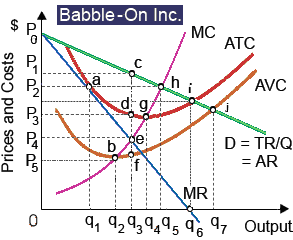
Babble-On maintains world-wide patents for software which translates any of 314 spoken languages within text, along with automatic audio and text translations within any of the other three-hundred-thirteen languages. When Babble-On is a pure monopoly, such firm confronts a demand curve which is: (w) identical to the industry demand curve. (x) perfectly price inelastic. (y) unitarily price elastic. (z) perfectly price elastic.
293_Market Power.png

I need a good answer on the topic of Economics problems. Please give me your suggestion for the same by using above options.

   Related Questions in Microeconomics

  • Q : Significant monopsony power-labor market

    The firm probable to have noteworthy monopsony power in its labor market would be the: (i) Big cotton farm in the Texas hiring migrant workers. (ii) Textile manufacturer in the Hong Kong hiring the factory workers. (iii) Janitorial service organization in London hirin

  • Q : Output level at demand in a

    Babble-On maintains world-wide patents for software which translates any of 314 spoken languages within text, with automatic audio and text translations in any of the other three-hundred-thirteen languages. Babble-On will never intentionally produce as well as sell vo

  • Q : Theory of the Firm The advantages that

    The advantages that firms confer on society do not comprise: (i) Decreasing the transaction costs. (ii) Raising consumer purchasing power. (iii) Facilitating the specialization in production. (iv) Raising the consumer demand. (v) Boosting the national income.

  • Q : Enter an industry by barriers to entry

    Barriers to entry: (w) make this complicated or impossible for new firms to profitably enter an industry. (x) uniformly violate U.S. antitrust statutes. (y) are fundamentally technological instead of economic. (z) stimulate aggressive competition.

  • Q : State marginal propensity to consume

    Marginal propensity to consume: It is stated as the measure of rate at which the aggregate consumption expenditure changes as the national income changes. MPC= C/Y

  • Q : Reducing elasticities of demands by

    By product differentiation, firms try to increase the: (w) demands for their products, when reducing elasticities of demands. (x) supply elasticities of competing products. (y) price elasticity of the demand for their products. (z) marginal costs of t

  • Q : Horizontal summation of individual

    The purely competitive industry’s demand for the labor is: (i) Less elastic than the horizontal summation of individual firm’s demands. (ii) Perfectly elastic. (iii) Upward sloping as of the diminishing marginal returns to labor. (iv) Equi

  • Q : Graphical relationship depicted by

    Demand curves graphically depict the relationships which are: (i) Positive among the demand for a good and its relative price. (ii) Negative between the quantity demanded and the opportunity cost of a good. (iii) Positive between income and expenditures. (iv) A horizo

  • Q : Kinked Demand by increasing price In

    In this kinked demand curve model as in demonstrated, when this firm operates at point a and increases its price from P2 to P3 and its rival firms respond by increasing their prices, in that case this firm will move from point a

  • Q : Problem on shortages or surpluses of

    The market is cleared when there are: (i) Buyers left waiting in line. (ii) Surplus supplies of unsold goods. (iii) No surpluses or shortages. (iv) Tendencies for the prices to increase. Can someone please help me in finding out th