--%>

Incurs total costs by profit maximization

This profit-maximizing brickyard as in illustrated figure incurs total costs of approximately: (i) $1200 daily. (ii) $1300 daily. (iii) $1400 daily. (iv) $1530 daily (v) $1600 daily.
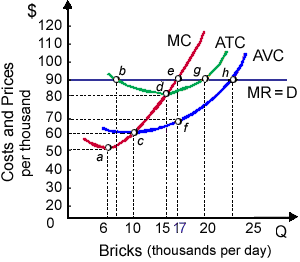
2450_Profit Maximization1.png

Can someone explain/help me with best solution about problem of Economics...

   Related Questions in Microeconomics

  • Q : Non-discriminating firm with monopsony

    I have a problem in economics on Resources and Products Flow Model. Please help me in the following question. The non-discriminating firm with the monopsony power in labor market confronts a: (1) Wage rate which consistently surpasses the marginal rev

  • Q : Define abnormal profit Abnormal profit:

    Abnormal profit: It is the gain earned over and above the normal profit.

  • Q : Definition of monopsonist The

    The individual or firm which is the sole buyer of the specific good or resource is a/an: (i) Monopolist. (ii) Oligopolist. (iii) Monopsonist. (iv) Monopolistic competitor. Find out the right answer from the above options.

  • Q : Maximizes total revenue by a monopolist

    A monopolist maximizes total revenue through producing where is: (w) marginal revenue = marginal cost [MR = MC]. (x) marginal revenue = 0. (y) demand is elastic. (z) demand is inelastic. How can I solve my

  • Q : Setting a price in profit-maximizing

    This profit-maximizing firm as in demonstrated figure will set a price where: (1) P > MC = MR. (2) MR > MC = P. (3) MR = P > MC. (4) MR = P > MC. (5) P < MC < MR.

    Q : Determine profit per unit of output

    Price minus average total cost i.e., P - ATC equals: (w) total profit. (x) marginal cost. (y) marginal revenue. (z) profit per unit of output. Please choose the right answer from above...I want you

  • Q : Labor Unions and Wage Differentials The

    The counter-argument to the idea which unions cause inflation is that the union negotiated wage hikes: (i) Are not excessive except W > average revenue products. (ii) Set the pattern for non-union wage negotiations. (iii) Tend to outcome in lower salaries in non-un

  • Q : Tax onto the mathematically impaired By

    By the opinion of public finance economists and financial analysts that the label “a tax onto the mathematically impaired” is most likely most applicable to: (1) land taxes. (2) income taxes. (3) inheritance taxes. (4) purchases of lottery

  • Q : Market economies of individual

    In the market economies, resources are finally owned by the: (i) Corporations which dominate the economic activity. (ii) Proprietorships and partnerships. (iii) Business firms collectively. (iv) Individual house-holds. (v) Government acting as the social trustee.

  • Q : Influence output price by market power

    Every firm which can considerably influence the price of its output: (i) is a pure monopoly. (ii) will be more profitable than any firm in pure competition. (iii) has market power: (iv) is essentially large relative to the market demand curve facing the firm. (v) has