--%>

Illustrate profit or loss on the cost curve graph

A firm's total profit can be computed as all of the given except w) total revenue minus total cost. x) average profit per unit times quantity sold. y) (price minus average total cost) multiply with times quantity sold. z) marginal profit times quantity sold.
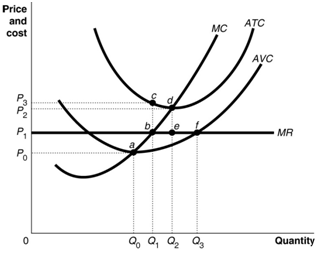
1545_Illustrating Profit or Loss on the Cost Curve Graph.png

How can I solve my economics problem? Please suggest me the correct answer.

   Related Questions in Managerial Economics

  • Q : Competitive demand of employer A

    A competitive demand of employer for labor is: (1) derived from the demand that exists for the firm’s output. (2) inverted compared to regular demands. (3) shifted rightward by hikes in real wage rates. (4) positively sloped. (4) determined thro

  • Q : Earning price in Human capital As per

    As per shown in this graph, the average high school graduate will earn around: (1) $12,000 yearly. (2) $20,000 yearly. (3) $45,000 yearly. (4) $90,000 yearly. (5) $100,000 yearly.

    Q : Human Capital and the Demand for Labor

    Investment in human capital is not essentially involved while: (w) people acquire and sharpen new productive skills. (x) a person attends college and learns engineering. (y) a person jogs to stay in shape. (z) the marginal productivity of labor increa

  • Q : Hiring additional workers exceeds the

    One purpose that firms hire labor at the point where w is equal to P x MPPL is: (1) if w < P x MPPL, the cost (w) of hiring additional workers exceeds the gains (P x MPPL) of hiring them, therefore they would hire fewer workers. (2) when w > P x

  • Q : Average Benefits in Human Capital and

    Throughout the past 50 years in the United States, there the average gains in lifetime income related along with having a college degree in addition to a high school diploma have: (1) declined since the larger proportion of the population that is college educated has

  • Q : Relation between Average Revenue

    Illustrates the relation between Average Revenue, Total Revenue and Marginal Revenue?

  • Q : Purely competitive labor market is

    When this purely competitive labor market is firstly in equilibrium at D0L, S0L, a move to equilibrium at D1L, S0L would be inconsistent along with increases in: (w) the price of output. (x) labor productivi

  • Q : Derived Demands for Resources Demands

    Demands for resources are derived since they: (1) depend upon producers supplies of such resources. (2) depend on consumers demands for the goods the resources produce. (3) rely on the availability of suppliers. (4) rely on the industry’s demand

  • Q : Decline in equilibrium marginal revenue

    Declines within the equilibrium marginal revenue product of a firm’s workers are probably to follow the adjustments to: (1) increases in specific training. (2) decreases in the wage rate. (3) increases in the demand for output. (4) hikes in the

  • Q : Explain the Cross elasticity of demand

    Explain the Cross elasticity of demand.