--%>

Greatest strategy for maximizing profit

Monsieur Cournot contains a monopoly on an artesian well from that flows tasty spring water reputed to have medicinal properties. To ignore incurring any variable costs, he is adamants that customers bring their own pails also fill them personally. Regrettably, Cournot cannot price discriminate since his customers all deal along with each other regularly. Cournot’s greatest strategy for maximizing profit is to: (w) maximize total revenue by selling the quantity of water where demand is unitarily price elastic. (x) sell 9,000 liters per period at a price of 3 Euros per liter. (y) charge each customer the most they are willing to pay for any water. (z) sell 3,000 liters per period at a price of 9 Euros per liter.
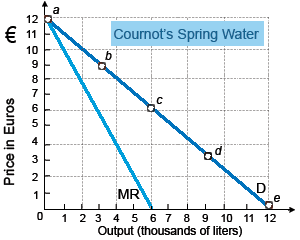
231_Elasticity and Total Revenue.png

How can I solve my Economics problem? Please suggest me the correct answer.

   Related Questions in Microeconomics

  • Q : Benefit of the market system One

    One political benefit of the market system over the majority of other economic systems is that: (1) The power to take decisions is comparatively decentralized. (2) Democratic decisions are steadier than individual selections (3) Centralized decisions

  • Q : Problem relating to current demands for

    The people who anticipate prices to increase soon will tend to rise their: (i) Current demands for the durable goods. (ii) Waiting time prior to buying. (iii) Saving as a result they can afford higher prices. (iv) Current supplies.

  • Q : Exclusivity ratio of ratio while price

    The percentage change within quantity supplied divided through the percentage change within price is an approx measure of a good's: (w) unitary margin. (x) price elasticity of supply. (y) exclusivity ratio. (z) price elasticity of demand.

    Q : Earning income within negative income

    Under the negative income tax system demonstrated in this figure, a family of four along with no earned income would have a net as after-tax, the income of: (1) $15,000 per year. (2) $10,000 per year. (3) $5,000 per year. (4) $2,500 per year. (5) $0 p

  • Q : Illustration of total revenue and

    The Square-Wheeled Locomotive, the last passenger train to Flatland, Iowa, wants more total revenue. When passengers’ demands for tickets are comparatively price elastic, in that case the railroad must: (1) raise the price, but lower this when d

  • Q : Rate of Return on Investment When the

    When the rate of return on investment equals the interest rate, in that case the optimal level of investment will: (w) rise. (x) fall. (y) not change. (z) Any of the above is possible.

    Q : Social Welfare and Value of Marginal

    I have a problem in economics on Social Welfare and Value of Marginal Product of Labor. Please help me in the following question. The social value of additional output from the additional units of labor is: (i) Marginal revenue of the product of labor

  • Q : Oligopoly in market structure Unlike a

    Unlike a monopolistically competitive firm, which an oligopoly is described by: (w) product differentiation. (x) extensive use of advertising. (y) conscious interdependence in decisionmaking by firms. (z) independence among firms.

    Q : Present Value and Rates of Return When

    When the annual interest rate is 12 percent and a rental house can be expected to rent perpetually for $1,000 monthly, rough computation suggests the house contain a present value of: (1) $240,000. (2) $144,000. (3) $100,000. (4) $72,000. (5) $12,000.

  • Q : What makes goods or resources valuable

    Can someone help me in finding out the precise answer from the given options. Modifying the goods or resources in manners that make them more valuable is: (1) Production. (2) Profitability. (3) Consumption. (4) Distribution.