--%>

Free rider problem

Question:

Explain why the free rider problem makes it difficult for perfectly competitive markets to provide the Pareto efficient level of a public good.

Answer:

A free rider is a person who cannot be excluded from the consumption or usage of a Public good, which is non-rivalrous and non-excludable in nature. The problem lies with the fact that these agents, the free riders, do not pay for the establishment and/or provision of the public good/property.

The free rider gains from this, as he/she gets all the gains from the good but does not have to pay anything for its provision.

Public goods have the special feature that if one person buys the good, everyone benefits from it. In this sense, the public goods have a positive externality attached to them. However, the free - rider issue leads to an undersupply of the public goods in a competitive market, as the perfectly competitive market does not take into account the externalities attached with a good.

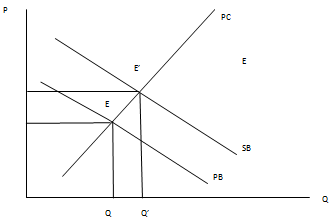
The graph below illustrates it:
2470_free rider problem.png

In the figure, PB denotes the personal benefit curve, SB denotes social benefits, and PC denotes personal cost. The optimal provision will be Q', taking into account the positive externality, however, the market equilibrium will be at Q, which does not take into account the positive externality of the public goods.

   Related Questions in Business Economics

  • Q : Explain the foundation of economics

    Explain the foundation of economics where society’s material wants are unlimited?

  • Q : Elucidate the overview of Business Cycle

    Elucidate the overview of Business Cycle?

  • Q : Individuals self-interests and broader

    A natural harmony among individuals serving their own self-interests and the broader interests of society was the main theme of the theories of __________, although this concept was not accepted through _________. Determine the correct answer from given options: (w) K

  • Q : Explain a refutation of the doctrines

    Adam Smith wrote his Wealth of Nations within part like a refutation of the doctrines: (1) classical liberalism. (2) utilitarianism. (3) mercantilism. (4) physiocracy. (5) laissez faire capitalism.

  • Q : Real rate of interest Question: Hubbard

    Question: Hubbard argues that the Fed can control the Fed funds rate, but the interest rate that is important for the economy is a longer-term real rate of interest.   How much control does the Fed have over this longer real rate?

  • Q : What is American made in today’s global

    Illustrates how hard it is to define what is “American made” in today’s global economy?

  • Q : Generalization and abstraction are

    Explain the statement: “Generalization and abstraction are nearly synonymous.”?

  • Q : Theory of Purchasing Power Parity

    Question: The Theory of Purchasing Power Parity says that, in the long run, nominal exchange rates change to offset changes in relative i. _________________________ so that the purchasing power of two currencies st

  • Q : Example of self interest to define

    The concept of _____ was demonstrated by _____ along with the quotation, “The defeat of a bit finger would remain the average European from sleeping which night,... but, given he never saw them, he will snore along with the most profound security over the loss o

  • Q : Historical process by Adam Smith of

    Writings on the historical process by Adam Smith of economic development do not comprise heavy reliance upon: (1) the development of property rights. (2) self interest. (3) divisions of labor in production processes. (4) innovations d