--%>

Example of temporary housing shortage

After the change within the demand curve for housing as: (1) a temporary housing shortage may exist at R0. (2) landlords will have more complexity repaying their mortgages. (3) rental rates will fall below interest payments. (4) equilibrium prices for houses will reduce. (5) a surplus of housing exists at R1.
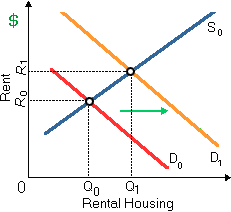
254_supply and demand curves for housing.png

I need a good answer on the topic of Economic problems. Please give me your suggestion for the same by using above options.

   Related Questions in Microeconomics

  • Q : Aggregate demand curve Choose the right

    Choose the right answer from following. The aggregate demand curve is: A) vertical if full employment exists. B) horizontal when there is considerable unemployment in the economy. C) downsloping because of the interest-rate, real-balances, and foreign purchases effect

  • Q : Excess of good in market problem The

    The excess of papayas would appear when: (1) seller’s supply prices increase to P1. (2) Govt. set a price ceiling of P1. (3) Growers predicted prices to soar. (4) Hurricane destroyed all Central American papaya plantations. (5) Government obliged a price floor o

  • Q : Law of comparative benefits Can someone

    Can someone please help me in determining the right answer from the following question. The law of comparative benefit exhibits: (a) Why trade with a country in which salaries are low is not fair. (b) How countries try to use each other via trade. (c)

  • Q : Effect of percentage change in price

    Give the answer of following question. When the percentage change in price is greater than the resulting percentage change in quantity demanded: A) a decrease in price will increase total revenue. B) demand may be either elastic or inelastic. C) an increase in price

  • Q : History of Labor Union problem Can

    Can someone help me in finding out the right answer from the given options. Working time gone in strikes as the percent of net working time in the United States since from the end of World War II has: (1) Rose to around 20 percent. (2) Reduced to a bit over 6 percent.

  • Q : Monopsony Power- Labors Immobility I

    I have a problem in economics on Monopsony Power and Immobility of Labor. Please help me in the given question. The immobility of labor is economically significant as: (w) Most of the people like to move, however can't. (x) People in high salary occupations won't be c

  • Q : Engage market power in price

    If this is possible, firms along with market power engage in price discrimination to: (i) defy civil rights legislation. (ii) help consumers. (iii) help the community. (iv) increase their profits. (v) reduce production costs.

  • Q : Legal barriers to entry in a market

    Governmentally-imposed obstacles to the entrance of new firms within a market are termed as: (1) regulatory barriers or legal barriers to entry. (2) strategic barriers to entry. (3) natural barriers to entry. (4) tax barriers to entry. (5) revenue blockades.

  • Q : Problem related to supply and demand

    Assume a drought in the Great Plains reduces the supply of wheat. Noting that wheat is a basic ingredient in the production of bread and that potatoes are a consumer substitute for bread, we would expect the price of wheat to: A) rise, the supply of bread to increase,

  • Q : Existence of purely competitive farm in

    This purely competitive rose farm would most likely exit in this industry with the long run when the wholesale price per dozen roses fell below: (i) $4.50 per dozen roses. (ii) $5.00 per dozen roses. (iii) $5.50 per dozen roses. (iv) $6.00 per dozen r