--%>

Effect on total revenue by raises price

A price raise from $6 to $8 would effect in: (1) a decrease in total revenue. (2) an increase in total revenue. (3) no change in total revenue. (4) consumers buying more pizza. (5) pizza parlors selling more pizza.
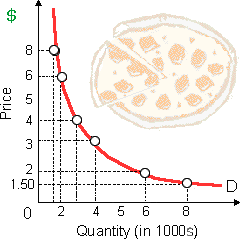
1167_pizza budgets graph.png

Please choose the right answer from above...I want your suggestion for the same.

   Related Questions in Microeconomics

  • Q : Reading Production Possibilities

    I have a problem in economics on reading the Production Possibilities Frontiers graph. Please help me in determining the right answer from the following question. The graph below depicts the mythical country of the Sandwichia’s:

    Q : Perfectly elastic supply problem When

    When will a rise in demand entail an increase in the quantity demanded however no change in the price?

  • Q : Problem on law of demand Let think

    Let think about the law of demand. The idea that a big price for a normal good will outcome in less of the good being bought never based logically on the: (i) Income effect. (ii) Demand for the good falling since of the higher price. (iii) Law of redu

  • Q : Screening and Credentialism The critics

    The critics of ‘credentialism’ suppose that firms making employment decisions tend to mainly rely too heavily on: (i) Personal contacts. (ii) Personality testing. (iii) Past experience. (iv) Job interviews. (v) Formal education and trainin

  • Q : Small market capitalization Why would

    Why would stocks perform better in the month of January than other months of the year, and discuss whether small market capitalization companies outperform large capitalization companies in the short to medium term?

  • Q : Price elasticity of demand at high and

    Moving by left to right along demand curve D, then price elasticity of demand for cheesy fried grits of Pixie is mostly: (w) positive, then unitary, then negative. (x) constant and equivalent to one. (y) greater at high prices than at low prices. (z)

  • Q : Probable quantity of the good by price

    Price discrimination which successfully increases profit does NOT needs the firm to be capable to: (1) separate the market within different groups along with different demand elasticities. (2) maintain entry barriers which defend a firm’s market

  • Q : Problem regarding to tax wedges in

    In equilibrium, a tax upon a good tends to because of the: (1) supply to exceed the demand. (2) quantity supplied to exceed the quantity demanded. (3) demand prices of consumers to exceed the supply prices of sellers. (4) competitive

  • Q : Perfect competition ‘In the real world

    ‘In the real world there is no industry which conforms precisely to the economist’s model of perfect competition. This means that the model is of little practical value

  • Q : Labor Union-union membership The basic

    The basic idea that unions are more influential than ever before is: (i) Supported by the consequences of unions on inflationary spirals. (ii) Reflected in the growing numbers of violent and expensive strikes. (iii) Contrary to the fact that union membership is refusi