--%>

Determine total revenue when maximizes economic profits

Total revenue when this firm maximizes economic profits would be: (w) $72,000 per period. (x) $80,000 per period. (y) $96,000 per period. (z) $100,000 per period.
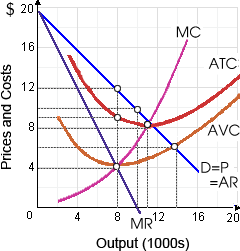
392_Price Discrimination.png

Can anybody suggest me the proper explanation for given problem regarding Economics generally?

   Related Questions in Microeconomics

  • Q : Assumption of Ceteris paribus Can

    Can someone help me in finding out the right answer from the given options. Suppose that everything except the variables we are studying remains constant or steady is termed as the: (1) Ceteris paribus assumption. (2) Ex-ante assumption. (3) Ex-post assumption. (4) Po

  • Q : Most desperate market participants of

    Tax burdens on transactions are probably to be disproportionately borne through the relatively as “most desperate” market participants those, who are: (1) sellers when the market supply curve is relatively

  • Q : Natural barriers to entry in network

    Assume that an equipment or software firm has copyrights and patents which restrict other firms from producing goods embodying its technology, and which the firm is shielded from competition since customers can deal along with each other at lower costs when they utili

  • Q : Determine demand over the relevant

    Predictions which higher gasoline prices will increase total spending on gas imply such as the demand over the relevant price range that is: (w) unlimited. (x) relatively price elastic. (y) unitarily price elastic. (z) relatively price inelastic.

  • Q : Income distribution line in Lorenz curve

    When line 0C0' shows the 1975 U.S. income distribution, in that case the 2005 income distribution would most likely be most probable: (1) line 0A0'. (2) line 0B0'. (3) line 0C0'. (4) line 0D0'. (5) line 0E0'.

  • Q : Substitution effect of income at wage

    Glynn’s preferences in between work and leisure give in a: (i) wealth effect that exceeds the leisure consequence above point c. (ii) weak preference for working more than 40 hours per week. (iii) substitution effect that exceeds the income effect at wage rates

  • Q : Legal barriers to entry in a market

    Governmentally-imposed obstacles to the entrance of new firms within a market are termed as: (1) regulatory barriers or legal barriers to entry. (2) strategic barriers to entry. (3) natural barriers to entry. (4) tax barriers to entry. (5) revenue blockades.

  • Q : Entry-exit in Long-run equilibrium of

    A competitive industry is in long-run equilibrium only after: (w) net pressure for entry or exit is zero. (x) each firm produces to its capacity. (y) owners reap all the profits they desire. (z) union bosses and firm managers reach mutual agreements.<

  • Q : Price elasticity of demand over price

    When the price Pixie’s Restaurant charges for its well-known cheesy fried grits rises from $2 to $4 and quantity demanded falls from 750 to 500 servings weekly, the price elasticity of demand over such price range is approximate

  • Q : Supply of labor curve problem Can

    Can someone please help me in finding out the accurate answer from the following question. Employer with the monopsony power which as well had the ability to wage discriminate perfectly would tackle a marginal factor cost of labor