--%>

Determine produce economic profit

When point e corresponds to $9,000 per RoboMaid, Robomatic can produce economic profit all month of at most around: (1) $25 million. (2) $40 million. (3) $55 million. (4) $70 million. (5) $85 million.
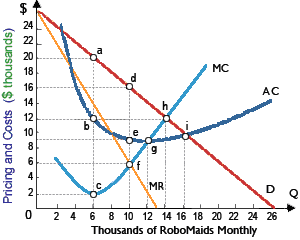
2223_Elasticity and profit.png

I need a good answer on the topic of Economics problems. Please give me your suggestion for the same by using above options.

   Related Questions in Microeconomics

  • Q : Costs of rate of return The rate of

    The rate of return for an asset which costs $1,500 today and pays $1,800 a year from now is: (1) 5 percent. (2) 10 percent. (3) 15 percent. (4) 17.5 percent. (5) 20 percent. Please choose the right answer from abov

  • Q : Meaning of Caveat emptor I have a

    I have a problem in economics on Meaning of Caveat emptor. Please help me in the following question. Caveat emptor signifies: (i) Let the seller beware! (ii) Everything else held steady. (iii) Let things modify if they should. (iv) Charge whatever the market will allo

  • Q : Capital Labor Ratios and Income Assume

    Assume that half of the world population, randomly certain, was magically vaporized through space aliens, although no other aspect of life onto Earth was influenced. Ignoring any psychological trauma that calamity might entail, upon average, the economic

  • Q : Buying something when expect a price to

    Buying since you expect a price to increase, at that point you will sell, which is termed as: (w) arbitration. (x) speculation. (y) profiteering. (z) arbitrage. Hey friends please give your opinion for the problem

  • Q : Labor Contracts-Shop Agreements From

    From the point of view of management, the favored union membership ranking (most favored to the least favored) would be: (i) Closed shop, union shop, agency shop and open shop. (ii) Open shop, agency shop, union shop and closed shop. (iii) Agency shop, open shop, clos

  • Q : Demand curve for physical economic

    The demand curve for physical economic capital based most directly onto the: (w) extent of previous automation. (x) willingness of savers to create investment funds available. (y) marginal productivity of capital and the price of its output. (z) suppl

  • Q : Problem on losing financial investments

     Can someone please help me in finding out the precise answer from the following question. Owners generally can’t lose more than their financial investments when a firm is a: (i) Proprietorship. (ii) Family business. (iii) Partnership. (iv) Corporation.

  • Q : Produce a natural monopoly by market

    Market forces tend to produce a natural monopoly while: (1) decreasing costs are small relative to market demand for output. (2) diseconomies of scale are substantial at low levels of output. (3) economies of scale are substantial relative to market d

  • Q : Supply in the short run and long run

    Supply is too elastic (contain a smaller coefficient) within the long run than in the: (w) short-run in competitive, constant-cost industries. (x) short-run in competitive, increasing-cost industries. (y) market period in virtually all industries. (z) All of the above

  • Q : Effects of less liquid assets on

    When households become more willing to hold less liquid assets, the: (w) interest rate rises. (x) present value of future income falls. (y) interest rate falls. (z) stock market will crash. How can I solve my