--%>

Determine price of unitary price elasticity of demand

St. Valentine’s Day software is currently going in version of 6.0. At this point on the demand curve where the price elasticity of demand is unitary, there the price would be approximately: (i) $20, resulting in roughly 16 million copies being sold. (ii) $27, resulting in approximately 13 million copies being sold. (iii) $32, resulting in roughly 10 million copies being sold. (iv) $40, resulting in about 6 million copies being sold. (v) $47, resulting in about 2million copies being sold.
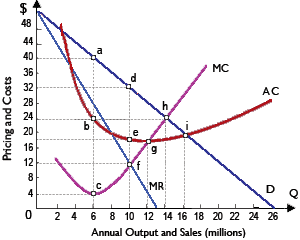
871_software of Elasticity.png

Can anybody suggest me the proper explanation for given problem regarding Economics generally?

   Related Questions in Microeconomics

  • Q : Sharing the characteristics of purely

    Purely competitive markets share the feature of: (i) collusive behavior among of large firms. (ii) freedom of entry and exit in the long run. (iii) extensive negotiations about prices in between buyers and sellers. (iv) widespread product differentiat

  • Q : Consumption expenditure In an economy

    In an economy 75% of increase in income is spent on the consumption. Investment raised by Rs. 1000 Crore. Compute: (A) Total increase in income(B) Total increase in consumption expenditure

  • Q : Meaning of tax Meaning of tax : Tax is

    Meaning of tax: Tax is a legally compulsory payment imposed on the people by the government. There are two kinds of taxes: Direct taxes and Indirect taxes.

  • Q : Price crosses elasticity of demand when

    When a 2% raise in the price of Kibbles causes a 1% raise in the quantity sold of Bits, in that case their price cross elasticity of demand is approximately _____ and such goods are _____. (w) -2; complements (x) 0.5; substitutes (y) 2; substitutes (z

  • Q : Movement according to economist Assume

    Assume that you purchased a ton of gold in Belgium for $450 per ounce and instantly sold all of it in Chile for $480 per ounce. Economists label your movement as: (i) Arbitrage. (ii) Scalping. (iii) Screening. (iv) Speculation. (v) Signaling.

    Q : Skill of dividing the labor work

    Whenever Janet and Bob realize that Janet is a better cook and Bob is better at cleaning the lawn, dividing such chores up according to skill is known as: (1) Gains from trade (2) Brute force allocation (3) Division of labor (4) Affirmative action.

    Q : Wage Differentials-occupational crowding

    The Disadvantaged groups have historically been pressured in the direction of low wage jobs in a process termed as: (i) Occupational crowding. (ii) Labor staggering. (iii) Systemic discrimination. (iv) Reverse favoritism. (v) Nepotism.

    Q : Define forward shifting of tax burden

    The greater the price elasticity of demand associate to the price elasticity of supply, then the: (i) greater the legal incidence of any tax burden. (ii) smaller the forward shifting of any tax burden. (iii) smaller the backward shift

  • Q : Competitive Profit Maximization-average

    The purely competitive firm which hires more workers if the value of marginal product of labor increases above the competitively set wage rate will certainly experience rises in its: (1) Overhead costs. (2) Profit per unit. (3) Average variable cost. (4) Marginal reve

  • Q : Influence of discount on Income Effect

    Jay saved $200 to purchase a Zowie digital camera following her friend showed Jay the Zowie she purchased for $200 at a close by camera store. Fortunately the camera was on sale for $150 all through a one-hour ‘Manager’s Special’ sale when Jay ultima