--%>

Determine average production cost by an example

When Robomatic Corporation maximizes profit in its production of RoboMaids, its average production cost per robot will be roughly: (1) $3,000 per robot. (2) $5,000 per robot. (3) $7,000 per robot. (4) $9,000 per robot. (5) $11,000 per robot.
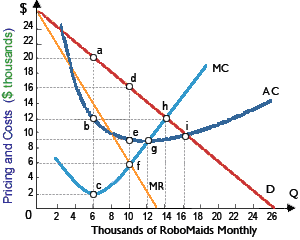
1002_Elasticity and profit.png

Hello guys I want your advice. Please recommend some views for above Economics problems.

   Related Questions in Microeconomics

  • Q : History-AFL-CIO The amalgamation of

    The amalgamation of American Federation of Labor, representing the craft unions and the Congress of Industrial Unions, representing the industrial unions, happened in: (i) 1955. (ii) 1960. (iii) 1970. (iv) 1965. (v) 1975. Find out

  • Q : Perfectly price elasticity of supply

    The supply of textile employees in China is possibly most like the perfectly price elastic supply curve within: (w) Panel A. (x) Panel B. (y) Panel C. (z) Panel D.

    Q : Illustrate an example of arbitrage

    Purchasing oil into Kuwait for $22 per barrel and selling that you purchased for $30 per barrel into Sao Paolo is an illustration of: (w) speculation. (x) bifurcation. (y) a subsidy. (z) arbitrage. I need a good answer on the topic

  • Q : Purely competitive industry in market

    Within a purely competitive industry: (w) firm faces a perfectly elastic demand for its product. (x) market demand is completely elastic. (y) individual firms set prices for their output. (z) supply curve is based on fixed costs.

    Q : Lowest possibility for price elasticity

    The price elasticity of demand would possibly be lowest for: (1) Dasani. (2) Deer Park. (3) Aquafina. (4) bottled water. (5) Perrier. Can anybody suggest me the proper explanation for given problem regarding

  • Q : Problem on greatest monopsony power The

    The Employers would have the maximum monopsony power in dealing with: (i) White collar labor in the metropolitan area. (ii) Unionized workers. (iii) Professional athletes. (iv) Blue collar labor in metropolitan area.

    Q : Protect monopolistic firms by barriers

    Barriers to entry which may protect monopolistic firms through losing market power across time do not comprise: (i) legal or regulatory barriers. (ii) artificial barriers. (iii) collusive barriers. (iv) strategic barriers. (v) natural

  • Q : Technology and human knowledge in

    The procedure in which the technology and human knowledge are employed to apply energy to convert materials to make the materials more precious is known as: (1) Social overhead. (2) Capitalism. (3) Production. (4) Construction. (5) Profit-seeking.

    Q : Purely-competitive output by profit

    Profit is maximized when this purely-competitive brickyard constructs at: (i) point a. (ii) point b. (iii) point c. (iv) point d. (v) point e.

    Q : Total cost for monopolistic competitor

    Total cost for that monopolistic competitor in shown below figure equals area: (w) 0cbQ. (x) 0deQ + dcbe. (y) 0paQ   cpab. (z) All of the above.

    Discover Q & A

    Leading Solution Library
    Avail More Than 1449786 Solved problems, classrooms assignments, textbook's solutions, for quick Downloads
    No hassle, Instant Access
    Start Discovering

    18,76,764

    1955207
    Asked

    3,689

    Active Tutors

    1449786

    Questions
    Answered

    Start Excelling in your courses, Ask an Expert and get answers for your homework and assignments!!

    Submit Assignment

    ©TutorsGlobe All rights reserved 2022-2023.